Skip to content
Dillman Family Association logo. © Dillman Family Association.

Dillman Family Association

Understanding the Heritage of Dillman Families and All Variant Spellings

Menu
  • Dillman Family Association
  • Start Here — New to Dillman Research?
  • Dillman DNA Project
    • Dillman DNA Participants
    • Family Group Sheets
    • Order A DNA Kit
    • Dillman DNA Project Donors
    • DNA Information Links
  • DFA Genealogical Conferences
  • Research Resources
    • The Dillman Surname
    • Dillman Family Settlement Concentrations and Migration Patterns
    • Dillman Family Association Library
    • Dillman Photographs
    • Helpful Tips and Hints
    • Military Links
    • Genealogical Will
    • Frequently Asked Questions
  • Reference & Resources
    • Quarterly Newsletter
    • DFA Newsletters
    • Dillman Bibliography: Published Genealogies and Family Histories
    • Discovering Dillman Families Throughout the World
  • Dillman Family Reunions
  • Forums
  • Join Us
    • Registration
    • Membership
  • DFA Blog
  • About DFA
    • Contact Us
    • DFA Officers and Committees
    • Data Collection and Privacy Policy at Dillman Family Association
  • Member Login
    • My Account
    • Password Reset
    • Profile
  • Dillman Family Research Tips

What Your Ethnicity Percentages Actually Mean (And What They Don’t)

No Comments
| Industry News
Colorful world map showing country-by-country data with a legend in the bottom-left corner.

Ethnicity estimates look precise and authoritative. They are neither. Understanding what the percentages actually represent — and what they cannot tell you about your documented ancestors — is one of the most useful things a genealogical DNA tester can learn.

Share this:

  • Share on Facebook (Opens in new window) Facebook
  • Share on X (Opens in new window) X
  • Share on WhatsApp (Opens in new window) WhatsApp
  • Share on Mastodon (Opens in new window) Mastodon
  • Share on Tumblr (Opens in new window) Tumblr
  • Print (Opens in new window) Print
  • Share on Bluesky (Opens in new window) Bluesky

Like this:

Like Loading…

Read More »

MacFamilyTree 11: The Best Genealogy Software You’ve Never Heard Of (If You’re on Windows)

No Comments
| Sites and Software
App icon featuring a white tree silhouette with many leaves on a teal rounded-square background, and a small shield in the bottom-right corner.

MacFamilyTree 11 is the most visually sophisticated genealogy desktop application available — and runs exclusively on Mac. With Apple’s App of the Year recognition, 27 years of development, and features like 3D globe visualization and heat-map statistics, it is the best-kept secret in genealogy software for Mac users.

Share this:

  • Share on Facebook (Opens in new window) Facebook
  • Share on X (Opens in new window) X
  • Share on WhatsApp (Opens in new window) WhatsApp
  • Share on Mastodon (Opens in new window) Mastodon
  • Share on Tumblr (Opens in new window) Tumblr
  • Print (Opens in new window) Print
  • Share on Bluesky (Opens in new window) Bluesky

Like this:

Like Loading…

Read More »

DFA Most Wanted: Family Group 112

No Comments
| DFA Most Wanted

The Philadelphia Dillmanns, settled by the mid-1840s from Germany — no immigration record, no DNA testing yet. Could you be connected?

Share this:

  • Share on Facebook (Opens in new window) Facebook
  • Share on X (Opens in new window) X
  • Share on WhatsApp (Opens in new window) WhatsApp
  • Share on Mastodon (Opens in new window) Mastodon
  • Share on Tumblr (Opens in new window) Tumblr
  • Print (Opens in new window) Print
  • Share on Bluesky (Opens in new window) Bluesky

Like this:

Like Loading…

Read More »

DNA Clustering and the Leeds Method: Making Sense of Your Match List

No Comments
| Genetic Genealogy
Diagonal color-coded collaboration heatmap with name labels along the top and left; red, orange, yellow, green, and blue blocks show clustered activity across the matrix.

DNA clustering — and the Leeds Method at its core — transforms an overwhelming list of DNA matches into organized groups of people who likely share the same ancestral line. It works on every major platform, requires no segment data, and is one of the most practical techniques in genetic genealogy.

Share this:

  • Share on Facebook (Opens in new window) Facebook
  • Share on X (Opens in new window) X
  • Share on WhatsApp (Opens in new window) WhatsApp
  • Share on Mastodon (Opens in new window) Mastodon
  • Share on Tumblr (Opens in new window) Tumblr
  • Print (Opens in new window) Print
  • Share on Bluesky (Opens in new window) Bluesky

Like this:

Like Loading…

Read More »

Why Sources Matter: An Introduction to Evidence Explained

No Comments
| Methodology & Standards

Elizabeth Shown Mills’ Evidence Explained set the standard for genealogical citation — and for the standards this site tries to hold its own research to.

Share this:

  • Share on Facebook (Opens in new window) Facebook
  • Share on X (Opens in new window) X
  • Share on WhatsApp (Opens in new window) WhatsApp
  • Share on Mastodon (Opens in new window) Mastodon
  • Share on Tumblr (Opens in new window) Tumblr
  • Print (Opens in new window) Print
  • Share on Bluesky (Opens in new window) Bluesky

Like this:

Like Loading…

Read More »

What’s in a Name: Naming Patterns in the Dillman Family Groups

No Comments
| Dillman Families
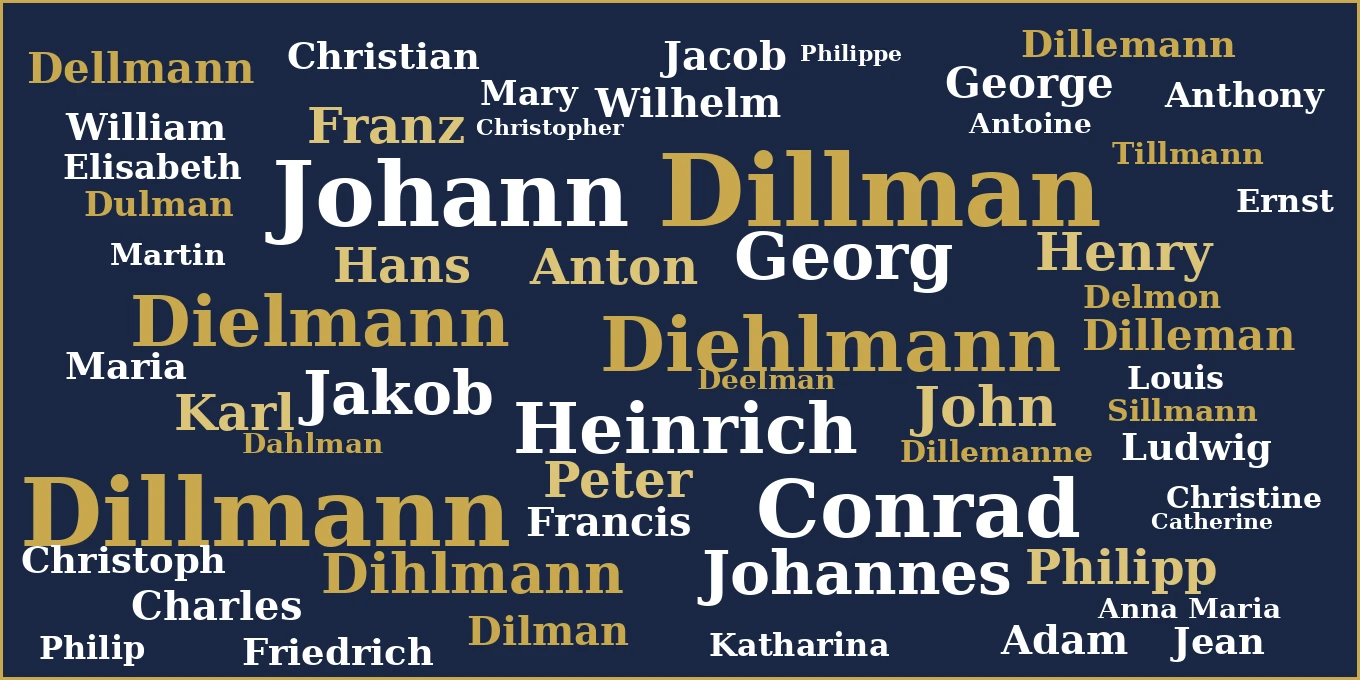
Word cloud of many German names on a dark blue background; largest names include Johann, Dillmann, Diehlmann, Conrad, Johannes, Heinrich.

The 160 family groups in the DFA database reveal consistent naming patterns across two centuries of Dillman migration — from the dominance of Johann in German records to the predictable anglicization that turned Heinrich into Henry and Georg into George at the American border.

Share this:

  • Share on Facebook (Opens in new window) Facebook
  • Share on X (Opens in new window) X
  • Share on WhatsApp (Opens in new window) WhatsApp
  • Share on Mastodon (Opens in new window) Mastodon
  • Share on Tumblr (Opens in new window) Tumblr
  • Print (Opens in new window) Print
  • Share on Bluesky (Opens in new window) Bluesky

Like this:

Like Loading…

Read More »

FamilyTreeDNA: The Specialist’s Choice for Serious Genealogical DNA Research

No Comments
| Industry News
FamilyTreeDNA (FTDNA) brand logo — © Gene by Gene, Ltd. Used for editorial purposes. Source: familytreedna.com

FamilyTreeDNA is the oldest consumer DNA testing company still operating under original ownership, and the only major platform offering all three test types: autosomal, Y-DNA, and mitochondrial. For Dillman researchers, its Y-DNA project infrastructure is unmatched anywhere else.

Share this:

  • Share on Facebook (Opens in new window) Facebook
  • Share on X (Opens in new window) X
  • Share on WhatsApp (Opens in new window) WhatsApp
  • Share on Mastodon (Opens in new window) Mastodon
  • Share on Tumblr (Opens in new window) Tumblr
  • Print (Opens in new window) Print
  • Share on Bluesky (Opens in new window) Bluesky

Like this:

Like Loading…

Read More »

Gramps: The Free, Open-Source Desktop Genealogy Software Worth Taking Seriously

No Comments
| Sites and Software

Gramps is free, open-source genealogy software with a 25-year track record that rivals paid desktop alternatives in analytical depth and data control. For researchers who value data ownership and serious source citation, it is worth the learning curve.

Share this:

  • Share on Facebook (Opens in new window) Facebook
  • Share on X (Opens in new window) X
  • Share on WhatsApp (Opens in new window) WhatsApp
  • Share on Mastodon (Opens in new window) Mastodon
  • Share on Tumblr (Opens in new window) Tumblr
  • Print (Opens in new window) Print
  • Share on Bluesky (Opens in new window) Bluesky

Like this:

Like Loading…

Read More »

Chromosome Browsers: Seeing Your DNA in a New Dimension

No Comments
| Genetic Genealogy
Karyotype image showing human chromosomes arranged in pairs, totaling 46 chromosomes in a standard layout.

A chromosome browser transforms a list of DNA matches into a visual map of shared segments across all 22 chromosomes. Understanding how to read that map — and how to use segment triangulation to confirm common ancestry — is one of the most powerful skills in genetic genealogy.

Share this:

  • Share on Facebook (Opens in new window) Facebook
  • Share on X (Opens in new window) X
  • Share on WhatsApp (Opens in new window) WhatsApp
  • Share on Mastodon (Opens in new window) Mastodon
  • Share on Tumblr (Opens in new window) Tumblr
  • Print (Opens in new window) Print
  • Share on Bluesky (Opens in new window) Bluesky

Like this:

Like Loading…

Read More »

What the Numbers Tell Us, Part Two: 160 Groups

No Comments
| Dillman Families

Sixty-six new Family Groups expand the Dillman dataset to 160 groups, revealing two distinct emigration waves with different causes, plus a stalled DNA project.

Share this:

  • Share on Facebook (Opens in new window) Facebook
  • Share on X (Opens in new window) X
  • Share on WhatsApp (Opens in new window) WhatsApp
  • Share on Mastodon (Opens in new window) Mastodon
  • Share on Tumblr (Opens in new window) Tumblr
  • Print (Opens in new window) Print
  • Share on Bluesky (Opens in new window) Bluesky

Like this:

Like Loading…

Read More »

Posts pagination

Previous 1 2 3 … 6 Next

Post Categories

  • DFA Most Wanted (4)
  • Dillman Families (9)
  • Dillman Genealogical Conference (2)
  • Genetic Genealogy (12)
  • Industry News (14)
  • Methodology & Standards (2)
  • Sites and Software (12)
  • Website News (2)

Recent Posts

  • Before Your Family Tree: What Ancient DNA Is Revealing About Who We Really Are
  • The FamilyTreeDNA Upgrade Is Here: $29 to Unlock 400x More Data
  • The Master Genealogist: A Legacy Worth Understanding
  • DFA Most Wanted: Family Group 30
  • The Dillman DNA Project: What It Is, What It’s Found, and How to Join

© Dillman Family Association 2026. Powered by WordPress

%d