
Data drawn from Dillman Family Association Family Group Fact Sheets and published historical sources. This article covers vessel and port connections documented in the first 94 family groups; additional examples will be incorporated as remaining groups are analyzed.
Every Dillman family in America arrived by water. Whether they crossed in the hold of an 18th-century sailing vessel packed with Palatine emigrants, as a uniformed soldier aboard a Hessian troop transport, in the steerage of a Hamburg-America Line steamship, or in a first-class cabin on the largest ocean liner in the world, the Atlantic crossing was the defining threshold of their story — the moment at which the old country ended and the new one began. The Family Group Fact Sheets document that crossing with varying degrees of precision: sometimes only the year and the port; sometimes the name of the vessel itself. This article examines what those records reveal about how Dillman families reached America, and what the ships and ports they passed through tell us about the broader story of German emigration across three centuries.
⚓️ Philadelphia and the German Immigrant Trade
Philadelphia was the primary port of entry for German immigrants in the 18th century. Between 1727 and 1775, more than 65,000 German-speaking immigrants arrived at Philadelphia alone, making it the largest German immigration gateway in colonial America.[1] The Pennsylvania colonial authorities required ship captains to submit passenger lists upon arrival, and these lists — now known as the Pennsylvania German Immigrant Lists — are among the most important genealogical records for 18th-century German-American families. Four Dillman family groups appear in or around these records, each arriving on a named vessel.
The earliest is Group 29 — Hans Georg Diehlmann of Zweibrücken, Germany, the first documented Dillman to reach North America. He arrived in Philadelphia in September 1737 aboard the Virtuous Grace, a vessel that made multiple transatlantic crossings carrying Palatine emigrants during this period. He was among the thousands of Germans who had traveled overland to Rotterdam or another Dutch port, waited weeks for a ship, and then endured a crossing that typically lasted six to twelve weeks under conditions that killed a significant proportion of passengers on some voyages.[2]
Group 7 (Jacob Daegen, ancestor of the Dillman/Dagga family) arrived in Philadelphia in 1740 aboard the Friendship. Group 2a (Conrad Dillmann and family, including the young George Adam Dillmann who would later fight at the Battle of Long Island) arrived in 1751 aboard the Brothers. Group 3 (the Erich Dihlmann family from Wurmberg, Germany) arrived in Philadelphia in 1755 aboard the Neptune.[3]
Four ships. Four Dillman family lines. All arriving within eighteen years of each other, all at the port of Philadelphia, all part of the same great wave of Palatine and southwest German emigration that transformed Pennsylvania’s demographic landscape in the mid-18th century. The ships themselves were not passenger liners in any modern sense — they were cargo vessels adapted for the emigrant trade, their holds fitted with temporary berths, their passenger lists recorded by colonial authorities more concerned with loyalty oaths than with passenger welfare. The families who arrived on them had typically sold or abandoned everything they owned to pay the passage.
A Soldier’s Crossing: The Hessian Troop Transports
Not every German who crossed the Atlantic to America in the 18th century came as a willing emigrant. Group 18 — Christoph Dillmann, later of Nova Scotia — arrived in North America in 1776 not as a settler but as a soldier, enlisted in the Hanau Artillery and transported across the Atlantic as part of the Hessian auxiliary forces hired by the British Crown to suppress the American Revolution. He was one of approximately 30,000 German soldiers who made this crossing, most of them in the years 1776 and 1777, aboard British naval transport vessels that bore no resemblance to the emigrant ships that carried civilian German settlers to Philadelphia.
The Hessian troop transports were military vessels operating under naval discipline, carrying soldiers who had little or no choice in the matter of their crossing.[4] Christoph Dillmann deserted shortly after arriving in North America, in May 1776, and eventually made his way to Nova Scotia, where he married and settled. His crossing illustrates a dimension of German arrival in America that genealogical research sometimes overlooks: the soldiers, deserters, and prisoners of war whose paths to settlement began not with an emigrant ship but with a military transport — and who became, in the end, some of the most permanently rooted of all German-American settlers, precisely because they had nowhere to return to.
New Orleans and the Southern Gateway
While Philadelphia dominated German immigration in the 18th century, New Orleans emerged as a significant alternative port of entry in the 19th century, particularly for German immigrants heading to the Mississippi Valley and the American interior. Several Dillman family groups entered the United States through New Orleans rather than the northeastern ports, reflecting the geography of their intended settlements.
Group 28 (Franz Dillmann of Klingenmünster, Rhineland-Pfalz) arrived in New Orleans in 1858, part of a significant German immigrant community that had been building in Louisiana since the early 19th century. He died there of yellow fever in 1870 — one of the recurring catastrophes that made New Orleans a dangerous port for immigrants, who arrived with no immunity to the tropical diseases endemic to the Gulf Coast. His son Frank Jr. survived and continued the family in the city.[5]

New Orleans, Louisiana, 1852. Several Dillman family groups arrived through this port in the 1850s, using Mississippi River steamboat connections to reach interior settlements. Public domain, via Wikimedia Commons.
Group 83 (Bernhardt Dillmann of Bavaria) also arrived in New Orleans in 1853, before making his way north to settle in Ashland, Schuylkill County, Pennsylvania. Group 84 (the Dillmann family from Westphalia) arrived via New Orleans in 1856. New Orleans functioned as a funnel through which German immigrants bound for the Mississippi Valley, the Ohio Valley, and the German settlements of Missouri, Illinois, and Indiana could pass without the lengthy overland journey from the northeastern ports. The steamboat connections up the Mississippi and Ohio rivers made it a practical gateway for interior destinations that would have been prohibitively expensive to reach overland from Philadelphia or New York.
New York and the Steam Age
By the mid-19th century, New York had surpassed Philadelphia as the dominant American port of entry for European immigrants, and the arrival of steam-powered ocean liners in the 1840s and 1850s transformed the crossing itself — reducing the typical Atlantic passage from six to twelve weeks under sail to ten to fourteen days under steam, and eventually to less than a week on the fastest express liners of the early 20th century.[6] Several Dillman family groups arrived through New York during this period, reflecting the port’s growing dominance.

Landing at Ellis Island, New York, 1902. More than 12 million immigrants passed through Ellis Island between 1892 and 1954, including several Dillman family groups. Library of Congress. Public domain.
Group 16 (the Kapsweyer Dillmanns of Rhineland-Palatinate) had Nicholas Dillmann arrive in New York in 1912. Group 26 (Adam Diehlemann of Germany) arrived in New York in 1881 and was naturalized as an American citizen in 1888. Group 43 (Wilhelm F. Dillmann of Oldenburg) arrived in New York in January 1929 — one of the last waves of German immigration before the Great Depression effectively ended mass transatlantic migration. In each case, the ship is not named in the Family Group Fact Sheet, but the port is: New York, the great funnel through which more than 12 million immigrants passed between 1892 and 1954 via Ellis Island alone.[7]
The Hamburg-America Line (HAPAG) and the Norddeutscher Lloyd (NDL) were the two dominant German shipping companies serving the New York route in the late 19th and early 20th centuries, and between them they carried the majority of German emigrants who arrived during this period. Their ships ranged from modest cargo-passenger vessels carrying emigrants in steerage to the great express liners of the Edwardian era — ships like the SS Imperator (1912), the largest ship in the world at its launch, which carried both emigrants below decks and wealthy transatlantic travelers in first class.
The Lusitania Connection
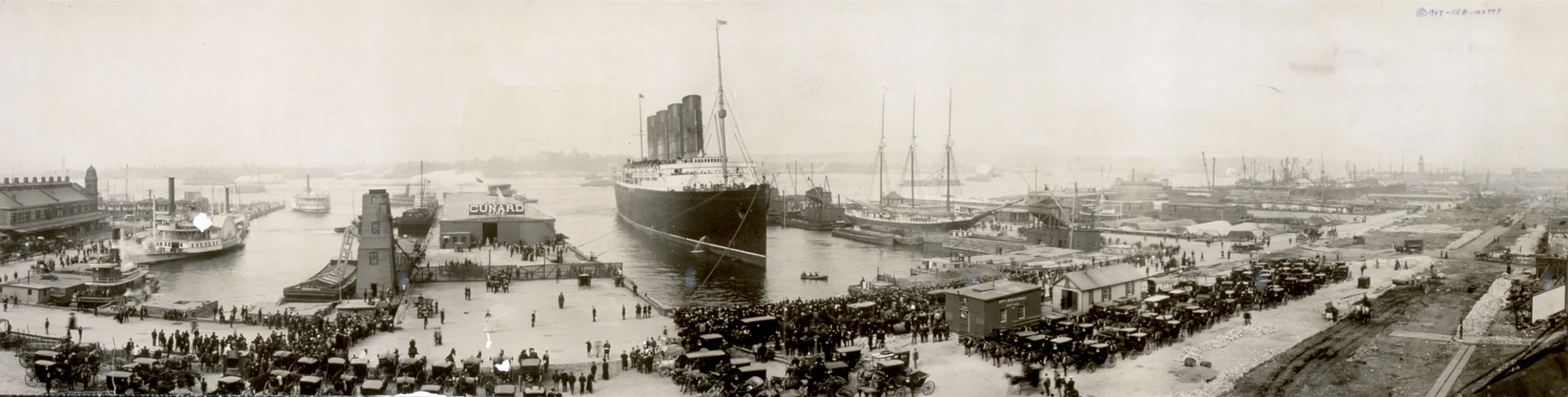
The most historically resonant single vessel connection in the documented Dillman groups belongs to Group 86 — a Jewish family from Gomel, Belarus, whose daughter Bernice arrived in New York in 1908 aboard the RMS Lusitania. She was one of thousands of passengers who crossed the Atlantic on this Cunard Line vessel during its years of regular service on the Liverpool–New York route.[8]

RMS Lusitania at the end of her record voyage, 1907 — the year before a Dillman family member crossed on her. Torpedoed and sunk May 7, 1915. Library of Congress, LC-USZ62-64956. Public domain.
The Lusitania was at the time one of the two fastest ships in the world — it and its sister ship the Mauretania had been built with British government subsidies specifically to win back the Blue Riband for Atlantic crossing speed from the German liners. In 1907, her first year of service, the Lusitania set a new westbound Atlantic crossing record of 4 days, 19 hours, and 52 minutes.[9] The crossing that brought Bernice to New York in 1908 would have taken less than five days — a journey that Hans Georg Diehlmann had spent six to twelve weeks making on the Virtuous Grace in 1737.
On May 7, 1915, the Lusitania was torpedoed by German submarine U-20 off the coast of Ireland and sank in eighteen minutes, killing 1,198 of the 1,959 people on board. Bernice had crossed on the same ship seven years earlier. The vessel that brought her family to America was destroyed in an act of war that helped bring the United States into the conflict — a historical arc that compresses into a single ship name the distance between the immigrant hope of 1908 and the catastrophe of 1915.
Halifax and the Nova Scotia Routes
Nova Scotia’s ports — particularly Halifax — served as entry points for a distinct stream of Dillman family arrivals: those connected to British colonial settlement, Loyalist migration, and the postwar reorganization of the Maritime provinces after 1783. Group 18’s Christoph Dillmann, having deserted from the Hessian artillery, made his way to Nova Scotia overland or by coastal vessel rather than arriving as a transatlantic immigrant in the conventional sense. Group 2a’s George Adam Dillmann — captured at the Battle of Long Island in 1776 and pressed into British service — was mustered out at Fort Edward, Windsor, Nova Scotia, in October 1783, arriving not as an immigrant but as a discharged soldier whose passage back across the Atlantic was simply not an option he chose to take.
By the early 20th century, descendants of the Nova Scotia Dillman lines were moving southward into New England via the Halifax–Boston steamship routes that connected the Maritime provinces to the northeastern United States. Group 18 documents that some 55 of Christoph Dillmann’s descendants made this southward migration, using the same maritime infrastructure that had originally brought their ancestor to Nova Scotia as a soldier.[10]
What the Ships Tell Us
The vessels documented across the Dillman family groups span nearly two centuries of transatlantic travel — from the Virtuous Grace in 1737 to the Lusitania in 1908. Between them lies the entire arc of the Atlantic crossing as a human experience: the six-week ordeal under sail in a crowded 18th-century emigrant ship; the military transport carrying soldiers who would become settlers; the steamship that compressed the crossing to days; and finally the express liner that made the Atlantic a commuter route for some and a desperate hope for others.
What the Family Group Fact Sheets preserve is not the full experience of any of these crossings — the records are too sparse for that. What they preserve is the fact of arrival: a name, a date, a port, and sometimes a ship. Hans Georg Diehlmann on the Virtuous Grace in 1737. Jacob Daegen on the Friendship in 1740. Conrad Dillmann and family on the Brothers in 1751. The Erich Dihlmann family on the Neptune in 1755. Bernice’s family on the Lusitania in 1908. These are the moments at which the Dillman families passed from one world into another, and the ships that carried them are the only monuments to that passage that time has preserved.
The remaining Dillman family groups — extending through Group 163 — will undoubtedly add further vessel and port connections to this picture. A follow-up article will examine the complete dataset when that data has been compiled.
The Dillman Family Association’s Family Group Fact Sheets are available to members at dillmanfamilyassociation.org. Researchers with additional information about vessels or ports of entry in their Dillman family lines are encouraged to contact the DFA to contribute to future updates.
Sources
- Marianne Wokeck, Trade in Strangers: The Beginnings of Mass Migration to North America (Penn State University Press, 1999), pp. 44–52; Pennsylvania State Archives, Pennsylvania German Immigrant Lists, 1727–1808.
- Dillman Family Association, Family Group Fact Sheet, Group 29 — Hans Georg Diehlmann of Zweibrücken, Germany (2021), dillmanfamilyassociation.org; Pennsylvania German Immigrant Lists, September 1737.
- Dillman Family Association, Family Group Fact Sheets, Group 7 (2023); Group 2a (2021); Group 3 (2021), dillmanfamilyassociation.org.
- Rodney Atwood, The Hessians: Mercenaries from Hessen-Kassel in the American Revolution (Cambridge University Press, 1980); Dillman Family Association, Family Group Fact Sheet, Group 18 (2021), dillmanfamilyassociation.org.
- Dillman Family Association, Family Group Fact Sheets, Groups 28, 83, 84 (2021), dillmanfamilyassociation.org.
- Wikipedia, “Hamburg America Line,” en.wikipedia.org (accessed June 2026); Wikipedia, “Norddeutscher Lloyd,” en.wikipedia.org (accessed June 2026).
- Wikipedia, “Ellis Island,” en.wikipedia.org (accessed June 2026); Dillman Family Association, Family Group Fact Sheets, Groups 16, 26, 43 (various dates 2021–2022), dillmanfamilyassociation.org.
- Dillman Family Association, Family Group Fact Sheet, Group 86 (2021), dillmanfamilyassociation.org.
- Wikipedia, “RMS Lusitania,” en.wikipedia.org (accessed June 2026).
- Dillman Family Association, Family Group Fact Sheet, Group 18 (2021), dillmanfamilyassociation.org.
AI Disclosure: This article was researched and written with the assistance of Claude, an AI assistant developed by Anthropic. Historical facts about specific vessels and shipping lines have been verified against published references. Information about DFA Family Groups is drawn from the Dillman Family Association’s Family Group Fact Sheets.
Discover more from Dillman Family Association
Subscribe to get the latest posts sent to your email.