
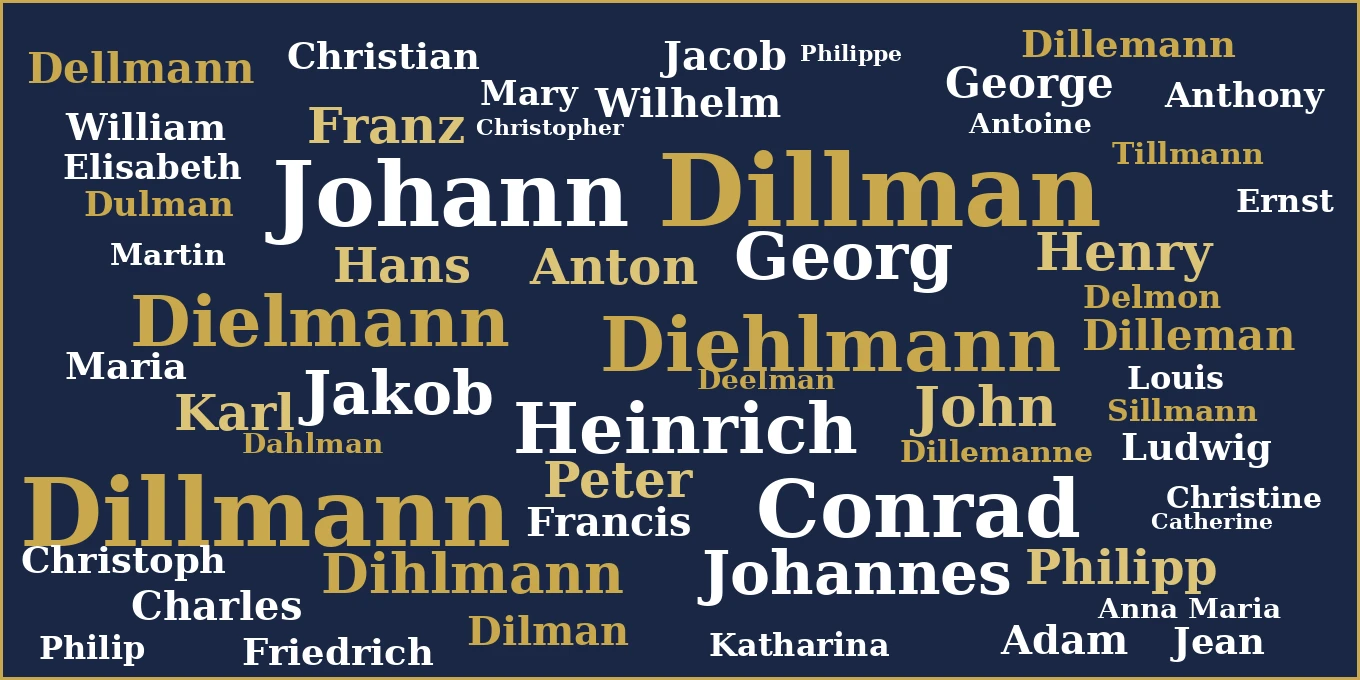
A genealogical database is many things — a record of migration, of occupation, of faith, of survival. But it is also, if you read it carefully, a record of names: the names parents chose for their children, the names that followed families across the Atlantic, and the names that changed shape as German speakers became American citizens. The 160 family groups documented in the DFA’s Family Group Sheet database offer a window into all three of these patterns, and what they reveal is both consistent and, at times, surprising.
The Dominance of Johann
No given name in the DFA database appears more frequently than Johann. Across both the immigrating ancestors and the farthest-back ancestors documented in the 160 family groups, Johann and its cognate Johannes account for 26 recorded individuals — far more than any other name. This is not coincidental. Johann was the dominant male given name in the German-speaking world for much of the eighteenth and nineteenth centuries, functioning less as a distinctive personal name than as a standard prefix: Johann Georg, Johann Heinrich, Johann Philipp, Johann Conrad. In many German-speaking communities, the first given name (the Rufname, or call name, by which a person was actually known in daily life) was typically the second name, not the first. A man recorded in a church register as Johann Heinrich Dillmann was likely called Heinrich by his neighbors and family.
This has significant practical implications for researchers. When a family group appears to “lose” a Johann in the American records — when the Johann who emigrated from Hesse in 1855 cannot be found in the 1860 census — the answer is often that he arrived as Johann Heinrich and was enumerated simply as Henry. The name was not lost; it was translated.
The Core Name Set
Beyond Johann, the database reveals a surprisingly compact set of given names that account for the majority of Dillman male ancestors. In rough order of frequency:
Conrad (9 occurrences) is the most distinctively Dillman name in the dataset — that is, the name most associated with the surname across multiple unrelated family groups. Multiple independent lines trace back to a Conrad, and the name recurs across groups from different German states, different immigration periods, and different variant spellings of the surname. Whether this reflects a naming tradition specific to Dillman families or simply the general popularity of the name in the German southwest is difficult to determine from the data alone, but its concentration is notable.
Heinrich/Henry (9 occurrences across both forms) follows, with the characteristic split between the German form used in origin records and the anglicized Henry that appears in American documents. This is one of the most consistent anglicization patterns in the database: Heinrich becomes Henry at or shortly after immigration, sometimes within the same family generation, sometimes not until the children are named.
Georg/George (16 occurrences across forms) shows a similar pattern — Georg in the German records, George in American ones — and is particularly common among families from Baden, Hesse, and Rhineland-Palatinate.
Jakob/Jacob (10 occurrences across forms) appears frequently enough to suggest it was a family naming tradition in several lines, particularly those from Baden and the Rhineland.
Peter (7 occurrences), Adam (6), Anton/Anthony (7), and Franz/Francis (7 across forms) round out the core male name set.
Anglicization: The Name at the Border
One of the most consistent patterns in the database is the predictable anglicization of German given names upon immigration to the United States. The transformations are systematic enough to constitute a practical translation guide for researchers working across German and American records:
- Johann/Johannes → John (the most common transformation)
- Georg → George
- Heinrich → Henry
- Karl/Carl → Charles
- Jakob → Jacob (often without further change, since the English form is close)
- Ludwig → Louis
- Franz → Francis or Frank
- Philipp → Philip
- Anton → Anthony
- Christoph → Christopher
These translations are not always immediate. In some family groups, the immigrant himself maintained his German name — appearing in naturalization records as Heinrich, for example — while his American-born children used Henry. In others, the transformation happened on the ship manifest or at the point of naturalization. The database contains examples of both patterns, with no clear regional or chronological rule governing which occurred.
A smaller number of names resisted anglicization entirely. Conrad, for instance, appears in the database in its German form in American records far more consistently than Heinrich or Georg. Whether this reflects the absence of a common English equivalent (Conrad has no obvious Anglo-American cognate) or simply the preferences of individual families is unclear, but it is a useful marker for researchers: Conrad in an 1870 American census is more likely to be a first-generation immigrant than Henry.
Female Names: A Thinner Record
The database documents significantly fewer female given names than male, reflecting both the naming conventions of the period (family groups were typically documented through the male line) and the patrilineal focus of much nineteenth-century genealogical record-keeping. Where female ancestors do appear, the most common names follow similar patterns to the male names: Maria (in multiple combinations, including Anna Maria, Marie, and Mary), Elisabeth/Elizabeth, Katharina/Catherine, and Christine. The anglicization pattern holds for female names as well: Maria becomes Mary, Katharina becomes Catherine, and Christine often survives unchanged.
The French Thread
Ten of the 160 family groups trace origins to France or Alsace-Lorraine rather than to the German-speaking heartland. These groups introduce a different naming tradition: Jean rather than Johann, Philippe rather than Philipp, Antoine rather than Anton. In several groups from Alsace — a region that spent the nineteenth century changing hands between France and Germany — both naming traditions appear within the same family, reflecting the political and cultural volatility of the border region. A grandfather named Jean becomes a father named Johann becomes a son named John, tracing the family’s path from French Alsace through German administration to American life, all in three generations of given names.
What the Names Reveal
Taken together, the naming patterns documented across the 160 family groups reveal several things that purely documentary genealogical research sometimes obscures.
First, the German-speaking Dillman families were culturally mainstream in their naming choices — they drew from the same pool of common Lutheran and Catholic names that appeared across the German-speaking world, not from a distinctive regional or family tradition. Researchers looking for a “signature” Dillman name will not find one in the first name; the surname itself is the identifier.
Second, the consistency of anglicization patterns means that American records can often be connected to German originals with reasonable confidence, even without documentary proof of the same individual, if the name transformation follows the expected pattern and the other evidence is consistent.
Third, the Johann prefix problem is real and widespread. Researchers who cannot find their Johann in American records should search systematically for every possible second name that might have become the American call name — a task the DFA’s family group documentation is specifically designed to support.
The names in this database are not decoration. They are data, and in the hands of a careful researcher, they point toward the records that contain the rest of the story.
Notes
- All family group data cited in this article is drawn from the Dillman Family Association, Family Group Sheet Database, compiled 2026; internal database, Dillman Family Association. Individual family group sheets are numbered and held by the DFA.
Discover more from Dillman Family Association
Subscribe to get the latest posts sent to your email.