
Data drawn from Dillman Family Association Family Group Fact Sheets and published historical sources. This article covers religious connections documented in the first 94 family groups; additional examples will be incorporated as remaining groups are analyzed.
When historians write about German immigration to America, they tend to emphasize the economic forces that drove it — crop failures, land scarcity, the lure of cheap land in the West. What receives less attention is the role that faith played not just as a comfort to the displaced but as an active organizing force: the reason some families left, the network that received them when they arrived, the community that determined where they settled and how far they moved. Looking across the first 94 Dillman family groups, faith emerges as one of the most consistent threads connecting the old world to the new — shaping migration patterns, defining community boundaries, and in at least one case determining a family’s relationship to military service across four generations.
This article examines the religious connections documented in the Dillman Family Group Fact Sheets: the pacifist Brethren who moved four times following their congregation; the Lutheran immigrants who found community in Philadelphia’s German churches; the Mennonite farmers of Lancaster County; the Catholic families whose parish records preserved their histories; the Jewish families who carried surname variants that sound like Dillman for reasons entirely unrelated to German ancestry; and the Anglican connection that links two otherwise very different Dillman lines in Nova Scotia.
✝️ The Brethren Migrations: Following the Congregation
The most distinctive faith-driven migration pattern in the documented Dillman groups belongs to Group 7 — the Dillman/Dagga family whose ancestor Jacob Daegen arrived in Philadelphia in 1740. This family belonged to the Church of the Brethren, a German Baptist denomination founded in Schwarzenau, Germany in 1708 whose early members emigrated to Pennsylvania in the 1710s and 1720s, well before Jacob’s own arrival.[1]
What makes Group 7’s migration pattern so distinctive is that for the next century, the family did not move for land or economic opportunity. They moved to stay with their congregation. From Pennsylvania, they relocated to Virginia in 1786. From Virginia to Ohio in 1816. From Ohio to Indiana in 1836. Each move tracked the westward spread of Brethren communities across the American frontier — communities that maintained the German language in worship, operated their own schools, and organized their social lives around the congregation rather than the township.
For a family in the Church of the Brethren, faith also meant a specific relationship to military service. The Brethren were one of three “historic peace churches” — alongside the Mennonites and the Quakers — whose members held conscientious objection to war as a matter of religious principle.[2] During the Revolutionary War, Brethren members who refused militia service faced fines or imprisonment. During the Civil War, the United States government formally recognized the Brethren as a peace church, allowing members to avoid combat by paying a commutation fee or hiring a substitute. The pattern of Group 7’s migration — always following the congregation, generation after generation — reflects a community that understood itself as distinct from the surrounding American culture in ways that went far beyond worship on Sunday morning.
The Lutheran Network: Philadelphia’s German Churches
For the majority of German Protestant immigrants who arrived in 18th and 19th century Philadelphia, the Lutheran church was not merely a place of worship — it was the primary institution through which German immigrant life was organized. St. Michael’s and Zion Lutheran Church, founded in 1743 and located on Cherry Street in Philadelphia, was the largest German Lutheran congregation in colonial America and one of the most significant German-language institutions in the country.[3] Its records document thousands of German arrivals in the colonial and early national periods, and several Dillman family groups appear within that world.

New Lutheran Church (St. Michael’s and Zion), Fourth Street, Philadelphia, founded 1743. The primary institution for German Lutheran immigrants in colonial America. Several Dillman family groups have documented connections here. New York Public Library Digital Collections. Public domain.
Group 29 — Hans Georg Diehlmann of Zweibrücken, Germany, the first documented Dillman to reach North America — arrived in Philadelphia in September 1737. Group 96 (Karl Dielmann of Birkenfeld, Rhineland-Pfalz) arrived in Philadelphia around 1854 and was married at St. Michael’s and Zion Church on June 5, 1859 — the same institution that had served German Lutheran immigrants for more than a century before him. Group 3, the Erich Dihlmann Group from Wurmberg, Germany, likewise has documented connections to Philadelphia’s German Lutheran community in the 18th century.[4]
The Mennonites of Lancaster County
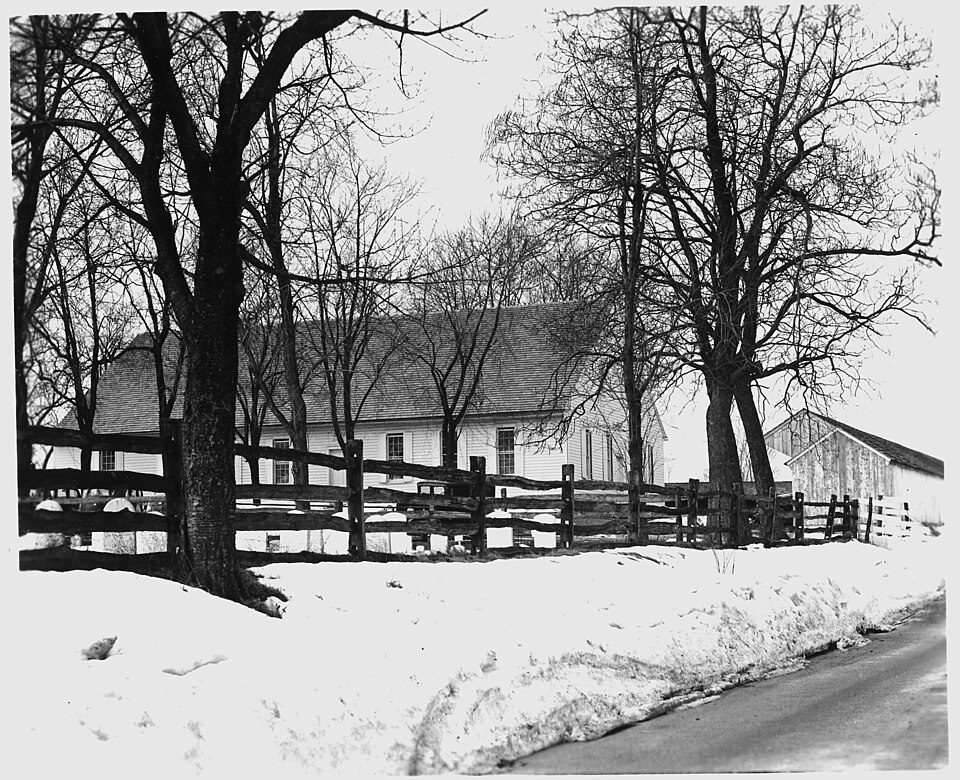
Group 89 — the Dillman family of Earl Township, Lancaster County, Pennsylvania — represents one of the oldest continuous Dillman presences in America, and one of the most distinctly faith-defined. George Dillman was born on March 27, 1801, and his wife Sarah was born on August 1, 1807. Both are buried in the Weaverland Mennonite Cemetery in Earl, Lancaster County — a congregation that traces its roots to the Swiss and German Mennonite immigrants who settled Lancaster County in the early 18th century.[5]

Meeting house of the Weaverland Conference Mennonites near New Holland, Lancaster County, Pennsylvania. George Dillman (Group 89) and his wife Sarah are buried in the Weaverland Mennonite Cemetery. US National Archives and Records Administration. Public domain.
The Mennonites of Lancaster County were among the most cohesive and self-sustaining immigrant communities in American history. Like the Brethren, they were Anabaptists — rejecting infant baptism, state churches, and the taking of oaths — and like the Brethren they were historic peace church members who refused military service. Unlike the Brethren, whose westward migrations followed the frontier, the Lancaster County Mennonites largely stayed put, building an agricultural community that persisted across two centuries. George Dillman’s burial in the Weaverland Mennonite Cemetery places his family squarely within that tradition.[5]
Catholic Parishes as Community Infrastructure
For Catholic German immigrants, the parish church served much the same organizing function as the Lutheran congregation did for Protestant arrivals. Several Dillman family groups have documented Catholic connections, and in each case the parish records preserve details that might otherwise be lost.
Group 84 (Johann Heinrich Dillmann of Recke, Westphalia) provides one of the most precisely documented religious records in the entire dataset: Johann Heinrich Dillmann married Maria Anna Bernardina Lewe on January 29, 1838, at St. Dionysius Catholic Church in Recke, Westphalia, Prussia. His daughter Bernhardine emigrated to the United States in 1856, arriving in New Orleans, and the family eventually settled in Kenton, Kentucky.[6]
Group 63 (Johann Dillmann of Trier, Rhineland-Pfalz) sent Anna Maria Dillmann to the United States in 1884, where she settled in Maine, Cook County, Illinois. Trier is one of the oldest cities in Germany and one of the most thoroughly Catholic — the seat of a bishopric since the 4th century. Group 83 (Bernhardt Dillmann of Bavaria) arrived in New Orleans in 1853, settled in Ashland, Schuylkill County, Pennsylvania, and served in the Union Army during the Civil War.[6]
The Jewish Dillman Families: Surname Laws and Coincidence
Five of the 94 documented family groups carry the Dillman surname or a phonetically similar variant, but trace their origins to Jewish communities in Eastern Europe rather than to German-speaking regions. These families are not related to the German-origin Dillman groups by ancestry. They carry similar-sounding names for a specific historical reason: the surname laws imposed across the Habsburg and Russian Empires in the early 19th century.
Beginning with the Habsburg decree of 1787 and followed by similar legislation in the Russian Empire, Jewish communities across Central and Eastern Europe were required by law to adopt hereditary surnames for the first time. Before these decrees, Jewish naming practices had been patronymic. The new laws required surnames to be chosen or assigned, often from a prescribed list of German-sounding names. The phonetic similarity between names like Delman, Delmon, and Dillman and the German surname Dillmann is coincidental — a product of the same alphabetical and phonetic logic applied to very different family histories.[7]
The five Jewish-heritage groups in the DFA dataset are geographically diverse: Groups 20 and 52 from Litin, Ukraine (likely related); Group 42 from Romania; Group 82 from Palestine/Israel; Group 86 from Gomel, Belarus — whose daughter Bernice arrived in New York aboard the RMS Lusitania in 1908, six years before that ship’s famous sinking. In each case, the families emigrated as part of the great wave of Eastern European Jewish migration between 1880 and 1924, driven by pogroms, poverty, and the systematic discrimination of the Pale of Settlement.[8]

Jewish immigrant children, 1921. Five Dillman family groups trace their origins to Jewish communities in Eastern Europe whose members adopted German-sounding surnames under 19th-century imperial surname laws. American Jewish Joint Distribution Committee. Public domain.
The DFA includes these groups in its research precisely because the surname similarity makes them likely to appear in the same genealogical indexes and databases as the German-origin Dillman families. Understanding the distinct historical origins of these groups is essential for researchers tracing either line.
The Anglican Connection: Nova Scotia and Two Opposite Roads
Two Dillman family lines ended up in Nova Scotia, connected by an unexpected thread of Anglican institutional life. Group 17 — the Tilghman family of Kent, England, who arrived in Virginia in 1638 — were Anglican by heritage, their migrations tracked through Anglican parish records across Virginia and Maryland. Group 18 (Christoph Dillmann, the Hessian deserter) married Margaret McDougald at St. George’s Anglican Church in Halifax, Nova Scotia, in 1785 — one of the oldest Anglican congregations in Canada, founded in 1750.[9]

St. George’s Anglican Church (the Round Church), Halifax, Nova Scotia, founded 1750. Christoph Dillmann (Group 18) married here in 1785. Photographer: Edward. Licensed under CC BY-SA 4.0, via Wikimedia Commons.
The connection between these two groups is not genealogical but institutional. For Christoph Dillmann, a German speaker who had deserted from the Hessian artillery and made his way to Nova Scotia, marrying into the Anglican community at St. George’s was an act of integration into the dominant social structure of his new home. The church record that preserves this marriage is one of the most evocative single documents in the entire DFA dataset — a German mercenary, married in an English church, in a British colonial city, under a name that connects him to family groups scattered across two continents.
What Faith Tells Us
Across the 94 documented Dillman family groups, faith appears in multiple roles simultaneously. For some families it was the engine of migration — the Brethren moving west to stay with their congregation. For others it was the infrastructure of arrival — the Lutheran churches of Philadelphia receiving German immigrants and connecting them to housing, employment, and community. For the Mennonites of Lancaster County it was the definition of place — a faith so tied to a particular landscape that it resisted the westward migration that drew other German communities away. For the Jewish families it was the source of the surname itself — a legal imposition that created a phonetic echo of a name carried by families with no connection to them whatsoever.
What the Family Group Fact Sheets make visible is that none of these patterns is incidental. Faith was not a private matter that happened alongside migration — it was woven into the logistics of migration, the choice of destination, the structure of community, and the records that preserved family history for future generations. The church registers of Trier, the Lutheran records of Philadelphia, the Mennonite cemetery of Lancaster County, and the Anglican register of St. George’s Halifax are, in many cases, the only reason we know these families existed at all.
The remaining Dillman family groups — extending through Group 163 — will undoubtedly add further religious connections to this picture. A follow-up article will examine the complete dataset when that data has been compiled.
The Dillman Family Association’s Family Group Fact Sheets are available to members at dillmanfamilyassociation.org. Researchers with additional information about religious affiliations in their Dillman family lines are encouraged to contact the DFA to contribute to future updates.
Sources
- Dillman Family Association, Family Group Fact Sheet, Group 7 — Dillman/Dagga Family (2023), dillmanfamilyassociation.org; Donald F. Durnbaugh, Brethren Beginnings (Brethren Press, 1992).
- Church of the Brethren, “History,” brethren.org (accessed June 2026).
- Pennsylvania Historical and Museum Commission, phmc.state.pa.us (accessed June 2026).
- Dillman Family Association, Family Group Fact Sheets, Groups 3, 29, 96 (various dates 2021–2022), dillmanfamilyassociation.org.
- Dillman Family Association, Family Group Fact Sheet, Group 89 — George Dillman of Earl, Lancaster County, Pennsylvania (2021), dillmanfamilyassociation.org; Weaverland Mennonite Church, Earl Township, Lancaster County, Pennsylvania.
- Dillman Family Association, Family Group Fact Sheets, Groups 63, 83, 84 (2021), dillmanfamilyassociation.org.
- Howard Aronson, “Jewish Surnames from the Austro-Hungarian Empire,” Avotaynu Vol. IX, No. 3 (Fall 1993); Alexander Beider, A Dictionary of Jewish Surnames from the Russian Empire (Avotaynu, 1993).
- Dillman Family Association, Family Group Fact Sheets, Groups 20, 42, 52, 82, 86 (various dates 2021–2024), dillmanfamilyassociation.org.
- Dillman Family Association, Family Group Fact Sheets, Groups 17, 18 (2021), dillmanfamilyassociation.org; St. George’s Anglican Church Halifax, stgeorgeshalifax.com (accessed June 2026).
AI Disclosure: This article was researched and written with the assistance of Claude, an AI assistant developed by Anthropic. Historical facts about specific religious institutions and communities have been verified against published references. Information about DFA Family Groups is drawn from the Dillman Family Association’s Family Group Fact Sheets.
Discover more from Dillman Family Association
Subscribe to get the latest posts sent to your email.