
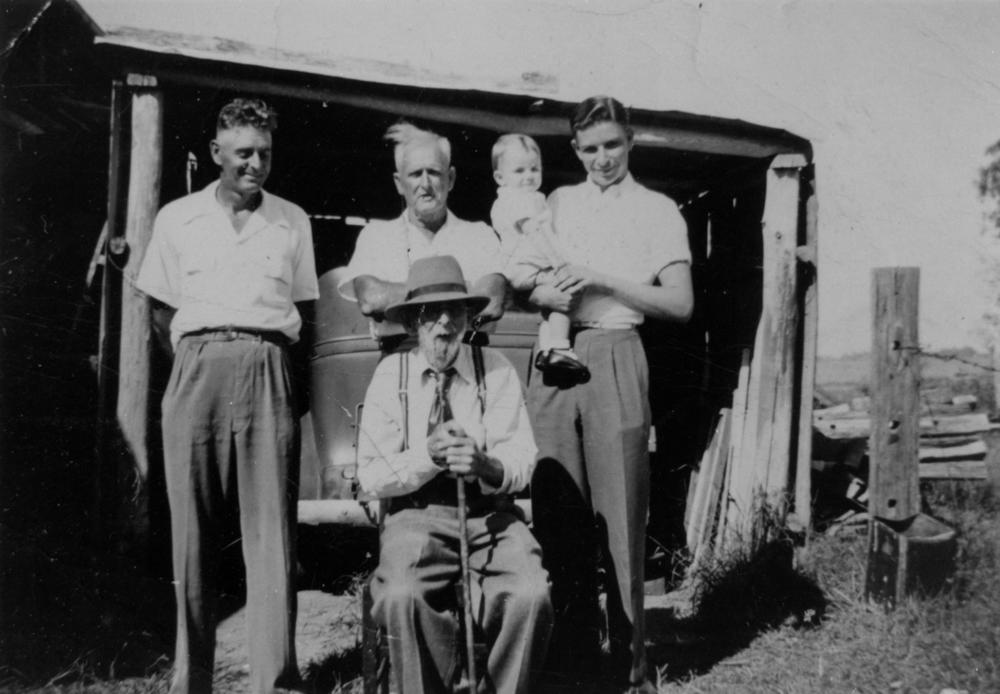
Featured image: Portrait of three generations of the Wright family, ca. 1930. John Oxley Library, State Library of Queensland, via Wikimedia Commons. Public domain.[9]
When the Dillman Family Association formed in 2002, its youngest member was 36, and most of the others were 50 or older. That youngest member is the DFA’s Webmaster today. He is 60 now, the age most of the founders were then. Those ages are his recollection; the DFA has not officially tracked the ages of its members.
Twenty-four years on, the pattern has hardened. Many of the early members have died. Others no longer travel to conferences because of their health. The newsletter archive puts numbers on the change. The first conference, in 2002, drew close to 80 people, while the group photographs from the 2022 and 2024 conferences show 18 and 17 people, and the Secretary counted 20 on the attendee list for 2026 (these kinds of count are not equivalent, as the section on the DFA’s record explains). By the Webmaster’s recollection, almost everyone who attends now is over 60. In all that time only a very small number of younger members have joined, and at least one of them first knew the DFA through an older family member.
That is not a problem the DFA invented, and it is not one the DFA can ignore. A society whose members are mostly past their fifties is a society whose conferences, officers, newsletter, and research are carried by a shrinking group, and the arithmetic does not improve by waiting. This series is about that arithmetic and about what a small genealogical society can honestly do about it. It begins here, with the problem, the evidence for and against our own assumptions, and a schedule for the four articles that follow.
The Premise We Are Starting From
Our working premise is simple. Genealogy tends to be a hobby of people who have watched family come and go and want to preserve what they know for those who follow. Younger people often lack that perspective, and many assume they have all the time in the world to start later, if they think of it at all. Older people tend to have more free time and more money to spend on the hobby. Societies like the DFA therefore fill with older members, struggle to attract new ones, and age out as members die or become unable to take part.
Part of that holds up. The best hard data we found is the Fullerton Genealogy Study, an online survey of 4,109 genealogists run in March 2001 as a master’s thesis project at California State University, Fullerton.[1] The respondents averaged 54 years old, ranging from 18 to 85, and 20 percent were 65 or older. They had begun researching at an average age of 40, and the study found that a concern with leaving something to future generations was tied to their interest in genealogy.[1] That fits the idea that the hobby arrives with a stage of life, not with a birthday. It also suggests that the typical genealogist of 2001 was middle-aged more often than elderly.
The limits are real. The survey is 25 years old, it was taken online in 2001 and so reached people who were comfortable online then, and it describes individual hobbyists, not societies. We could not find a rigorous dataset of the ages of society members. The two practitioner sources we read describe declining membership and attendance without giving society-wide figures.[2][3] The comparison with the DFA is therefore rough. Conference attendees who are almost all over 60 are older than the 2001 survey’s average of 54, but the two groups were measured a quarter century apart, and the comparison is suggestive at best.
Interest Is Not the Problem
If the premise is only partly right, the missing piece may be the assumption that younger people do not care. The evidence we found points the other way. In a YouGov poll of 1,001 U.S. adults on December 3–4, 2024, 23 percent of adults aged 18 to 29 and 17 percent of those aged 30 to 44 said they planned to take a DNA test in the next six months, against 6 percent of those 45 to 64 and 4 percent of those 65 and older who said they were considering one.[4] The poll asked about any DNA test, health tests included, and about intentions, not purchases, so it measures curiosity, not genealogy. Even so, DNA is the clearest place where younger interest and our field meet. Our articles on what ethnicity percentages actually mean and on how genetic genealogy helps adoptees find family are two places we have already started on that ground.
What happens after the test is the harder part. Amy Johnson Crow argues that younger people respond to stories and clear benefits, bristle at the word “research,” and need a personal invitation more than a pitch.[5] Her evidence is anecdote, chiefly an interview with her millennial daughter, and she cites no survey, so we treat her argument as a hypothesis worth testing, not a finding.[5] David Rencher, speaking to Texas society leaders in 2021, argued that societies lose members when they stop giving them value, and that online genealogy companies are not the cause.[2] For people aged 16 to 30 he recommended mentoring over simple recruiting: invite them onto the board, pair each with a mentor, and offer a free first year of membership or a member to sponsor the fee.[2] A writer for the Larimer County Genealogical Society makes a related point about conferences. They mostly draw people who already know societies, so a society hoping to find newcomers has to go where newcomers already are.[3]
We read these as one challenge. A thirty-year-old is not waiting for permission to care about family history. What a younger person needs is a reason to join us in particular, and a way to do it that does not feel like entering a club built for someone else. Whether the DFA has such a reason is a question this series intends to examine honestly.
What the DFA’s Own Record Shows, and What It Does Not
The DFA has held a genealogical conference every other year since 2002, thirteen in all through 2026, including a virtual one in 2020. The DFA Family Library, a collection of documents, photographs, and family histories, travels to each conference.[6]
Attendance is recorded in the Dillman News archive when it is recorded at all, so we read the issues that cover each conference and kept two kinds of figure apart. Some issues state a number in words. Others give none, and for those the only evidence is the number of people in the published group photograph or, for 2020, in a screen capture of the Zoom session. For 2026 the figure is the Secretary’s count of the attendee list, from an e-mail. Only a stated number is a headcount. A photograph shows the people who were present when it was taken, and the report on the 2010 conference says that a few attendees could stay only the first day and are not pictured.[7]
| Year | Where | Attendance | Kind of figure | Source |
|---|---|---|---|---|
| 2002 | Plainfield, Indiana | Close to 80 | Stated | Vol. 1, No. 1 |
| 2004 | Cincinnati, Ohio | None located | — | — |
| 2006 | Harrisburg, Pennsylvania | Nearly 45 | Stated | Vol. 11, No. 1 |
| 2008 | Indianapolis, Indiana | About 40 | Stated | Vol. 1, No. 1 |
| 2010 | Roanoke, Virginia | 24 | Photo | Vol. 3, No. 1 |
| 2012 | Fort Wayne, Indiana | 24 | Photo | Vol. 5, No. 1 |
| 2014 | Plainfield, Indiana | More than 40 | Stated | Vol. 7, No. 1 |
| 2016 | Fort Wayne, Indiana | 21 | Photo | Vol. 8, No. 4 / Vol. 9, No. 1 |
| 2018 | Plainfield, Indiana | 23 | Photo | Vol. 10, No. 4 |
| 2020 | Virtual (Zoom) | 17 online at one moment | Zoom screen capture | Vol. 12, No. 4 |
| 2022 | Harrisburg, Pennsylvania | 18 | Photo | Vol. 14, No. 4 |
| 2024 | Louisville, Kentucky | 17 | Photo | Vol. 16, No. 4 |
| 2026 | Erlanger, Kentucky | 20 | Attendee list | E-mail from the Secretary |
Conference attendance from Dillman News and, for 2026, an e-mail from the Secretary. “Stated” is a number the newsletter gives in words; “Photo” is a count of the people visible in the group photograph, which is a minimum; “Attendee list” is the Secretary’s count of the list of attendees circulated for the 2026 conference, which may differ from the number who came. Locations are from the DFA’s conference page.[6][7][10]
Read with care, the table says three things. The largest figures come first: close to 80 at the inaugural conference in 2002, then nearly 45 in 2006 and about 40 in 2008. The photographs of the 2022 and 2024 conferences show 18 and 17 people, the Secretary counted 20 names on the attendee list for 2026, and the one Zoom capture from the virtual 2020 conference shows 17 online at that moment. And the photograph counts are floors, not totals. The one year in which a stated number sits beside its neighbors is 2014, which the newsletter puts at more than 40 attendees, between photographs of 24 (2012) and 21 (2016). Either 2014 was an unusually good year or a photograph can understate a turnout by a wide margin, and the record does not say which. Location also matters: the DFA’s conference page notes that Plainfield, Indiana, has historically drawn the largest attendance.[6]
What the record supports is therefore narrower than a trend line and firmer than a hunch. Turnout was highest at the start, stated figures were about 40 to 45 in 2006, 2008, and 2014, and the three most recent in-person conferences were counted at 17 to 20 people, two by photograph and one from an attendee list. We cannot say how steady the decline was.

The rest of the picture is missing too. The DFA has not officially tracked the ages of its members, and we have no reliable count of members over time, so this series will not estimate either. What we have, apart from the conference counts, is observation: who comes to conferences, who has died, and who has joined. Ages in the series are the Webmaster’s recollection or general descriptions, and no member is identified by age.
Observation still counts for something, and the losses are real. Don A. Dillman, the DFA’s longtime president and an internationally recognized survey methodologist, died in June 2024, and the DFA’s tribute to him ran in the newsletter that summer.[7] Each loss takes more than a name off a roll. A society that depends on a shrinking group for its conferences, its newsletter, and its research is on a clock, and the members who remember how the DFA began may not be here in twenty years to explain it. That is the practical problem. By the accounts of the practitioners cited above, the DFA is not alone in it.
What the Series Will Cover
The series runs on the DFA’s usual every-other-Saturday Industry News schedule, five parts from November 28 through January 23. The titles below are working titles and may change.
Part 2 arrives on December 12 as “The Graying of Genealogy: What the Evidence Says.” It looks harder at who actually does genealogy, tests the myths about young people and the hobby, and asks whether DNA is the doorway it appears to be.
Part 3, on December 26, is “What a Younger Researcher Needs From a Society.” It asks what the DFA offers that a free website does not, what roles a newcomer could take, what membership costs, and how hard it is to join. Dues can already be paid by Zelle, PayPal, or check, and we will look at whether other methods, such as Venmo, are worth adding.
Part 4, on January 9, is “Where They Are: Reaching Younger Researchers Online.” It covers the platforms that reach younger adults, which of them the DFA can use without producing video, and what the DFA already does there.
Part 5, on January 23, is “What Every Member Can Do.” Recruiting is not only the officers’ job. This part covers the simple, practical steps any member can take, starting with the people already in their own families.
Tell Us How You Found the DFA
The most useful evidence for this series is the kind we cannot look up: how people actually came to the DFA. How did you hear of it? Who brought you? If you have tried to interest a younger relative, what worked and what did not? Send your answers to the Webmaster. We will not use any identifying information, including age, without your explicit permission.
Sources
- Drake, Pamela J. “Findings from the Fullerton Genealogy Study.” Master’s thesis project, Department of Psychology, California State University, Fullerton. Copyright 2001. Accessed October 2026. psych.fullerton.edu/genealogy.
- Rencher, David E. “Membership Growth in a Shifting Landscape.” Talk, Texas State Genealogical Society Leadership Forum, 2021. Accessed October 2026. txsgs.org.
- Larimer County Genealogical Society. “Expanding the Reach of Genealogy Societies and Conferences.” Larimer County Genealogical Society. January 13, 2023. Accessed October 2026. lcgsco.org.
- Shah, Kineree. “Understanding American Consumers’ Interest and Concerns in DNA Testing.” YouGov. December 5, 2024. Accessed October 2026. business.yougov.com.
- Crow, Amy Johnson. “The Truth About Millennials and Genealogy.” Amy Johnson Crow. January 31, 2019. Accessed October 2026. amyjohnsoncrow.com.
- “DFA Genealogical Conferences.” Dillman Family Association. Accessed October 2026. dillmanfamilyassociation.org.
- “Dillman News.” Dillman Family Association. Issues cited: Vol. 1, No. 1 (September 2008); Vol. 3, No. 1; Vol. 5, No. 1; Vol. 7, No. 1; Vol. 8, No. 4 / Vol. 9, No. 1; Vol. 10, No. 4; Vol. 11, No. 1; Vol. 12, No. 4; Vol. 14, No. 4; Vol. 16, No. 4 (June–August 2024). Issue summaries appear in the public Dillman News Newsletter Index; the issues themselves are in the members’ archive. Accessed October 2026. The 2020 figure is a count of the participants visible in the Zoom screen capture printed in Vol. 12, No. 4.
- Lee, Russell. [Annual reunion of the England family, about three hundred people attending], August 11, 1946 (inline image). U.S. National Archives and Records Administration, NAID 540763. Wikimedia Commons. Public domain. commons.wikimedia.org.
- “Portrait of three generations of the Wright family, ca. 1930” (featured image). John Oxley Library, State Library of Queensland, via Wikimedia Commons. Public domain. commons.wikimedia.org.
- Secretary, Dillman Family Association. Unpublished e-mail counting the attendees listed for the 2026 Genealogical Conference, Erlanger, Kentucky.
AI Disclosure: This article was researched and written with the assistance of Claude, an AI assistant developed by Anthropic. Online sources were accessed in October 2026.
Discover more from Dillman Family Association
Subscribe to get the latest posts sent to your email.