
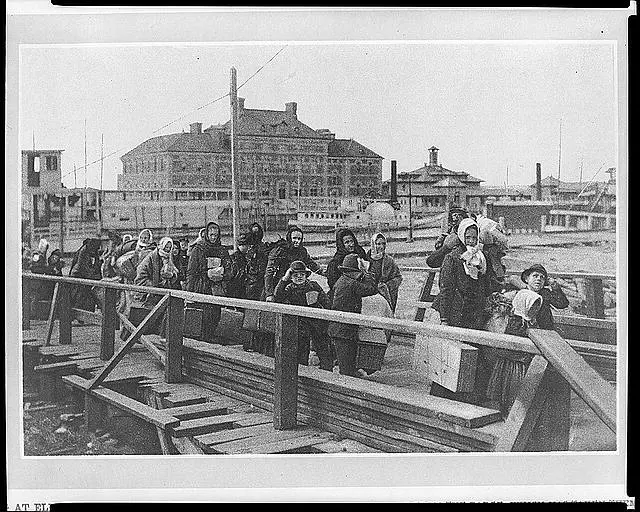
In 1926, a young decorator named Franz Dillmann arrived in Gervais, Oregon, his passage paid for by his uncle, Otto Bittler. The same year, Franz’s sister or cousin made the same crossing to the same small Oregon town — her ticket, too, covered by the same uncle. Nothing about that story is unusual, and that is exactly the point. Of the handful of Family Group Sheets that record what happened after the immigrating ancestor’s own arrival, a real and recognizable pattern keeps surfacing: people did not simply scatter into a new country. They followed each other into it.
A Term With a History
Sociologists have a name for this: chain migration, a term coined in a 1964 study of how immigrant social networks shape where newcomers settle, and one that has described a real, well-documented historical phenomenon for six decades.[1] One relative arrives, gets established, and then draws others after them — sometimes by paying their fare, sometimes just by being a known contact at the other end of the voyage, sometimes only by being family worth joining.
Only 39 of the DFA’s 200 Family Group Sheets currently have anything recorded in the “Subsequent Migration Events” field, and a handful of those are too thin to say much — a bare year, a single word. That leaves a documented sample of roughly three dozen groups, not a statistical picture of the whole family. What follows draws on the ones with real detail.

Someone Already There
The clearest cases in the database are the ones where a sheet names the specific relative who was waiting on the other side — and there is a documentary reason sheets can be this precise. Starting in 1893, U.S. immigration law required passenger manifests to record whether an arriving immigrant was joining a relative already in the country, along with that relative’s name, address, and relationship to the passenger.[2] That single record-keeping requirement is why a family history a century later can still name names.
Group 131 (Ase/Abraham Dulman/Dilmaon of Boston, Massachusetts and Odessa, Ukraine) is the fullest example: a Jewish family from Odessa arrived in New York in the early 1900s to join a daughter and son-in-law, Rose and Jacob Kausner (later Kushner), who were already established there. Three more arrivals followed within about five weeks of each other in February and March 1904, and the 1910 U.S. Census shows several of them still living together in the Kushner household — not a family tradition, but a fact recorded in a federal document.
Group 53 (John Dillmann of New Norka, Saratov, Russia) shows the same mechanism from the other direction: when John’s son Heinrich crossed into the United States in June 1913, his sheet names his “arrival contact” as his uncle Ludwig Krain, who had himself only been in the country since 1911. The uncle was barely settled and already functioning as the next arrival’s point of contact.
Paid Passage
A few sheets go further than naming a contact and record who actually paid for the trip. Franz Dillmann’s 1926 crossing to Gervais, Oregon (Group 169, Franz Dillmann of Gervais, Oregon and Tettnang, Wurttemberg, Germany) was financed by his uncle, Otto Bittler — and when a sister or cousin followed him to the same small town later that same year, Bittler paid her way too. Group 8 (Mathias/Matthew Dillmann Line) records a simpler version of the same idea: two brothers, Jacob H. and Peter Dillmann, both arriving in Baltimore within roughly a year of each other around 1870, with nothing to suggest their timing was coincidental.
A Generation-Long Trickle
Not every chain moved quickly. Group 137 (Diehlmanns of Louisville, Kentucky and Nassau, Rhineland-Palatinate, Germany) traces five Catholic immigrants from the same corner of Germany arriving in Kentucky over 33 years — Johann Karl in 1849, Lorenz in 1854, Jacob in 1868, Stephan in 1869, and Joseph in 1882. Johann Karl, the first to arrive, ran a grocery store; by the time Joseph landed, an entire generation had passed. A single family’s migration, in other words, was not always a single event, but the slow work of decades.
Group 16 (Kapsweyer Dillmanns) is a useful counterexample to keep the pattern honest. Four siblings left the same German-French border region between 1872 and 1894, but they did not converge: Alois and Michael went to Ohio, Joseph went to California, and Nicholas went to New York. A shared origin did not always mean a shared destination — sometimes a family’s migration fanned out rather than followed a single thread.
Moving West After Arrival
A separate, quieter pattern shows up in the sheets that track a family’s movement after they were already in North America. Group 7 (Dillman/Dayga Family) is the clearest case: Germany to Philadelphia in 1740, Philadelphia to Virginia in 1786, Virginia to Ohio in 1816, Ohio to Indiana in 1836 — four moves across four generations, each one carrying the family a little further west as American settlement itself moved that direction. Group 181 (George Joseph Dillmann of Ontario, Canada and Koblenz, Rhineland-Palatinate, Germany) shows a smaller-scale version that ran in both directions: Charles’s son Herman moved to Cleveland, Ohio in 1888 and became a U.S. citizen, then moved back to Canada after his father’s death in 1897 and never returned — a reminder, in miniature, that the pattern of coming back this series has already explored in Going Back wasn’t limited to transatlantic crossings.
What the Free Text Remembers
Some of what turns up in this field isn’t a migration pattern at all, just a detail a bare list of arrival dates would never preserve. Group 3 (The Erich Dihlmann Group) documents roughly twenty different family members arriving in the United States between 1839 and 1924, and tucked into that long list is a note that one of them, Johann Andreas, who arrived in 1855, worked as a barber and — according to the family’s own record — once cut Abraham Lincoln’s hair. There is no way to independently verify a claim like that, and this article isn’t asserting it as fact; it’s offered here as exactly what it is, a piece of family lore preserved in a free-text field that a purely statistical count of arrivals would have discarded.
Three Dozen Sheets, One Real Pattern
Thirty-some documented cases out of 200 groups is not enough to say how common chain migration was across the whole Dillman surname — only that where the record is detailed enough to see it, the pattern is real and repeats in recognizable forms: a named contact, a paid fare, a household shared with relatives already there, or a slow trickle across a generation. (This series has already told the fullest version of a related pattern — the 55 descendants of Group 18 who used the same Nova Scotia-to-Boston route for over a century — in The Ships That Brought Them, so it isn’t repeated here.) Most sheets don’t yet have anything in this field at all, which most likely means the detail hasn’t been added yet, not that the migration was a solitary event.
If your own family’s sheet includes a passenger list, a naturalization record, or even a family story about who paid for whose ticket, the “Subsequent Migration Events” field is where that detail belongs.
Sources
- MacDonald, John S., and Leatrice D. MacDonald. “Chain Migration, Ethnic Neighborhood Formation, and Social Networks.” The Milbank Memorial Fund Quarterly 42, no. 1 (1964). Accessed September 2026. milbank.org.
- “Learning More About Your Ancestors.” National Park Service, Ellis Island. Accessed September 2026. nps.gov/elis.
- “Going Back: Return Migration in the Dillman Families.” Dillman Family Association. June 2026. dillmanfamilyassociation.org.
- “The Ships That Brought Them: Dillman Families at Sea.” Dillman Family Association. July 2026. dillmanfamilyassociation.org.
- Dillman Family Association, Family Group Sheet Database, compiled 2026; internal database, Dillman Family Association. Individual family group sheets are numbered and held by the DFA.
- “Over-the-Rhine, Cincinnati, Ohio.” Historic photograph, early 20th century. Public domain (U.S. publication predates 1931).
AI Disclosure: This article was researched and written with the assistance of Claude, an AI assistant developed by Anthropic. Online sources were accessed in September 2026.
Discover more from Dillman Family Association
Subscribe to get the latest posts sent to your email.