
Data drawn from Dillman Family Association Family Group Fact Sheets and published historical sources. This article covers military service documented in the first 94 family groups; additional connections will be incorporated as remaining groups are analyzed.
Among the most striking findings in the Dillman Family Association’s Family Group Fact Sheets is the breadth of military service documented across the family groups. Dillman families and their relatives did not merely witness the great conflicts of American and European history — they were soldiers in them, on multiple sides, across five wars spanning nearly two centuries. This article examines the military connections documented in the first 94 family groups: from a Pennsylvania rifleman captured at the Battle of Long Island in 1776, to a Soviet Army prisoner of war who survived a Nazi prison camp and rebuilt his life in Australia. Between those two points lie stories of Hessian deserters, Civil War volunteers, German Army infantrymen, and one of the most complex military biographies in the entire dataset.
⚔️ The American Revolution: Two Dillmans on Opposite Sides
The most extraordinary military finding in the documented Dillman groups is that two separate family lines — Groups 2a and 18 — both served in the American Revolution, and both ended up in Nova Scotia afterward. But they arrived there by completely different routes, having served on opposite sides of the same war.
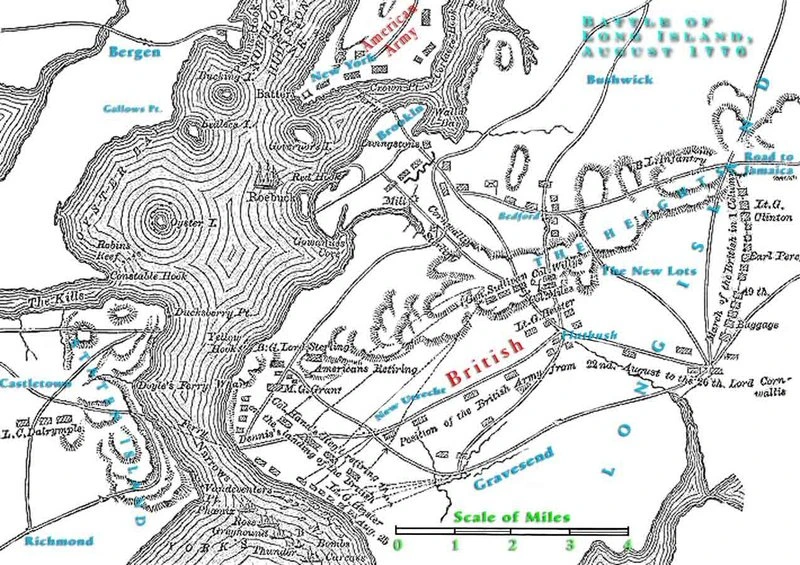
George Adam Dillmann (Group 2a) was born in 1749 in Neureut, Baden, Germany, and had come to America as a child with his parents in 1751. By 1776 he was living in Bethel Township, Berks County, Pennsylvania, and on April 9 of that year he and his brother Andreas enlisted in the Pennsylvania Rifles at Lancaster. They fought at the Battle of Long Island on August 27, 1776 — the first major engagement of the Revolution following the Declaration of Independence, and a decisive British victory that drove Washington’s forces from Brooklyn. After the battle, George was listed as missing. He next appears on a list of 130 prisoners taken by the British and was sworn into the 2nd Battalion of the British 84th Regiment of Foot — the Royal Highland Emigrants — on September 3, 1776. He was mustered out at Fort Edward, Windsor, Nova Scotia in October 1783, and his first land deed in Parrsborough, Nova Scotia, is dated 1788. His descendants used the names Dillman and Stillman interchangeably across generations of Nova Scotia records.[1]
Hessian Grenadier, Colonel Rall’s Regiment, Hesse-Cassel, c. 1776. Christoph Dillmann (Group 18) served in the Hanau Artillery before deserting in May 1776. Watercolor by Charles M. Lefferts, c. 1910. New York Historical Society. Public domain.
Christoph Dillmann (Group 18) arrived in North America by an entirely different path. He is documented in the Hessian military records as having enlisted in the Hanau Artillery in April 1776 — one of the approximately 30,000 German soldiers hired out by their princes to serve the British Crown in America.[2] He deserted in May 1776, just weeks after his enlistment, and made his way to Nova Scotia. He received 300 acres of land in Musquodoboit River, Halifax County, in 1790, recorded as a Hessian soldier. He married Margaret McDougald at St. George’s Anglican Church, Halifax, in 1785, and over many years some 55 of his descendants migrated to the United States via Halifax–Boston trading routes.[3]
Two Dillman men, both German-born or German-descended, both ending their war in Nova Scotia. One had fought for the Revolution as a Pennsylvania rifleman and been captured. The other had been sent to fight against the Revolution as a German mercenary and chosen to desert. The Revolution brought them to the same place by opposite roads.

The Civil War: Union Soldiers in Pennsylvania and Missouri

Unidentified soldier, Union uniform, 119th Pennsylvania Volunteer Infantry, c. 1861–1865. Bernhardt Dillmann (Group 83) enlisted from Schuylkill County, Pennsylvania in 1862. Library of Congress, Liljenquist Family Collection. No known copyright restrictions.
Two Dillman family groups have documented connections to the American Civil War (1861–1865), both on the Union side. German immigrants in Missouri were particularly significant in the early months of the war: most of the volunteers in Missouri’s early Union regiments were ethnic Germans, generally opposed to slavery and strongly supportive of the Unionist cause, playing a decisive role in keeping Missouri from seceding.[4]
Group 35 (Gerhard Dillmann of Hesse, Germany) arrived in June 1844, settling in Ohio before moving to Missouri. The Family Group Fact Sheet documents that Gerhard served in a Missouri regiment during the Civil War.[5]
Group 83 (Bernhardt Dillmann of Bavaria, Germany) arrived in New Orleans in 1853 and settled in Ashland, Schuylkill County, Pennsylvania. Bernhardt enlisted in the Union Army on November 25, 1862, and was discharged on August 8, 1863. He married Louisa Herlemann and had four children before his death on January 13, 1873 — a German immigrant who had been in the country less than a decade when he took up arms for his adopted nation.[6]
World War I: Fighting on Both Sides of the Atlantic
World War I (1914–1918) presents the Dillman family story with its most divided chapter. By the early 20th century, Dillman families had been in the United States for several generations in some cases, while other branches had remained in Germany. The result was that the same surname appeared in the armies on both sides of the Western Front.

German Imperial Army soldiers at Christmas, 1917. Both Wilhelm F. Dillmann (Group 43) and Anton Dillmann (Group 71, 2nd Bavarian Infantry Regiment) served in the Imperial German Army during World War I. Public domain, via Wikimedia Commons.
Group 43 (Johann Heinrich Dillmann of Hanover, Germany) documents Wilhelm F. Dillmann, born in Oldenburg, who served in the German Army in World War I before emigrating to the United States in January 1929. His son, the Reverend Alan W. M. Dillman, was born in New York in 1933.[7]
Group 71 (Franz Xavier Dillmann of Aschaffenburg, Bavaria) documents Anton Dillmann, born August 2, 1891, enlisted in the 2nd Bavarian Infantry Regiment during World War I. He married in Berlin in 1918 and by 1920 was living in Munich.[8] Dillman families, separated by the Atlantic and by generations, found themselves in opposing trenches during the same war — a direct consequence of the migration patterns that the DFA’s research documents.
World War II: A Soldier Between Two Worlds
The most complex military biography in the entire dataset of 94 groups belongs to Edmund Dillmann of Group 24 — a man whose very identity placed him at the intersection of the two great opposing forces of World War II.
Edmund’s family were descendants of German settlers who had migrated to Prischib, Ukraine (then part of the Russian Empire) in the late 18th century, when Catherine the Great invited German colonists to farm newly acquired territories near Crimea. These Black Sea Germans maintained their German language and culture across generations while living as subjects of the Russian Empire and later the Soviet Union. By the time Edmund was an adult, he was simultaneously German by ancestry and Soviet by citizenship — a paradox that the war would make catastrophic.
When Germany invaded the Soviet Union on June 22, 1941, Edmund was working in Moscow. He was drafted into the Soviet Army and sent to the Western Front — a Soviet citizen of German descent, fighting against Germany. He was captured by German forces and transferred to a prisoner of war camp (Lager) in Freiburg, where he was put to work as a translator. His German heritage and linguistic background made him valuable for this role, but it placed him in an impossible position: a Soviet prisoner, of German stock, in a German camp, translating between the two worlds that had each claimed him.[9]
Meanwhile, his first wife and son were taken to Soviet labor camps in Kazakhstan. Stalin’s government regarded the Volga Germans, Black Sea Germans, and other German-heritage Soviet citizens as a potential fifth column, and hundreds of thousands were deported to labor camps beginning in 1941. Edmund’s family were among them. Edmund survived the camp, remarried, and emigrated to Australia in 1950, settling in Randwick, Sydney. He died on January 7, 1958. His military experience encapsulates one of the least-told stories of World War II: the German-heritage communities of the Soviet Union, who were neither German enough for Germany nor trusted enough for Stalin.[9]
The Church of the Brethren: Faith as an Alternative to Arms
Not all Dillman military connections involve combat. Group 7 — the Dillman/Dagga family whose ancestor Jacob Daegen arrived in Philadelphia in 1740 — belonged to the Church of the Brethren, a pacifist German religious tradition. Rather than following economic opportunity, this family moved from Pennsylvania to Virginia in 1786, from Virginia to Ohio in 1816, and from Ohio to Indiana in 1836, each time following their congregation.
For the Church of the Brethren, conscientious objection to military service was a matter of faith. During the Revolutionary War period, Brethren members were subject to fines or imprisonment for refusing militia service. During the Civil War, members could avoid combat by paying a commutation fee or hiring a substitute. The pattern of migration in Group 7 reflects a community that organized its entire life around its religious identity, including its relationship to military service.[10]
What the Service Records Tell Us
The military connections documented across the 94 Dillman family groups span four conflicts — the American Revolution, the Civil War, World War I, World War II, and the pacifist tradition of the Church of the Brethren. Dillman men fought as American patriots and as captured prisoners pressed into British service. They fought as Union soldiers in Missouri and Pennsylvania. They fought as German Imperial Army infantrymen in World War I while their distant cousins fought on the other side. One of them survived the Eastern Front, a Nazi prison camp, and Soviet labor camps.
These are not the stories of a single family with a unified military tradition. They are the stories of many distinct families whose lives were shaped by the great conflicts of their times in ways that the Family Group Fact Sheets have preserved for future generations to discover. The remaining Dillman family groups — extending through Group 163 — will undoubtedly add further military connections to this picture. A follow-up article will examine the complete dataset when that data has been compiled.
The Dillman Family Association’s Family Group Fact Sheets are available to members at dillmanfamilyassociation.org. Researchers with additional information about military service in their Dillman family lines are encouraged to contact the DFA. Information is current as of the date of this article.
Sources
- Dillman Family Association, Family Group Fact Sheet, Group 2a — Conrad Dillmann of Knielingen, Georg Adam Dillmann/Stillman branch (2021), dillmanfamilyassociation.org.
- Wikipedia, “Hesse-Hanau troops in the American Revolutionary War,” en.wikipedia.org (accessed June 2026).
- Dillman Family Association, Family Group Fact Sheet, Group 18 — Dillmans from Meaghers Grant, Nova Scotia (2021), dillmanfamilyassociation.org.
- Wikipedia, “1st Missouri US Reserve Corps Infantry Regiment,” en.wikipedia.org (accessed June 2026).
- Dillman Family Association, Family Group Fact Sheet, Group 35 — Gerhard Dillmann/Dollmann of Missouri and Hesse (2021), dillmanfamilyassociation.org.
- Dillman Family Association, Family Group Fact Sheet, Group 83 — Bernhardt Dillmann of Pennsylvania and Bavaria (2021), dillmanfamilyassociation.org.
- Dillman Family Association, Family Group Fact Sheet, Group 43 — Johann Heinrich Dillmann of Hanover, Germany (2021), dillmanfamilyassociation.org.
- Dillman Family Association, Family Group Fact Sheet, Group 71 — Franz Xavier Dilmann of Aschaffenburg, Bavaria (2021), dillmanfamilyassociation.org.
- Dillman Family Association, Family Group Fact Sheet, Group 24 — Prischib, Ukraine Dillmanns (2021), dillmanfamilyassociation.org.
- Dillman Family Association, Family Group Fact Sheet, Group 7 — Dillman/Dagga Family (2023), dillmanfamilyassociation.org; Donald F. Durnbaugh, “Brethren Beginnings: The Origins of the Church of the Brethren in Early Eighteenth-Century Europe,” Brethren Press, 1992.
AI Disclosure: This article was researched and written with the assistance of Claude, an AI assistant developed by Anthropic. Historical facts about specific conflicts and military units have been verified against primary sources and published references. Information about DFA Family Groups is drawn from the Dillman Family Association’s Family Group Fact Sheets.
Discover more from Dillman Family Association
Subscribe to get the latest posts sent to your email.