
Migration is never random. People follow rivers, railroads, and relatives. They settle where earlier arrivals from the same village have already staked out ground, where the land looks familiar, where the church holds services in their language. The 199 family groups now documented in the DFA’s Family Group Sheet database make this visible in specific, traceable terms: where the Dillman families came from, when they left, and where they ended up. Thirty-nine new groups have joined the database since this settlement map was first drawn, and the patterns they add mostly confirm what was already visible — while sharpening a few details that a larger dataset can finally show with real precision.
The German Heartland
Of the 199 family groups now documented, 140 trace their origin explicitly to Germany. The remainder come from France and Alsace (9), the Netherlands (6), England (6), Russia, Ukraine, and Belarus (8), Scandinavia (4), Austria (2), Hungary (2), and a scattering of others including Poland, Romania, China, Belgium, Italy, and Palestine (1 each) — considerably more geographic diversity than the original 160-group survey showed, reflecting both genuine new arrivals to the database and a wider net cast in this pass to actually trace each birthplace to its historical region rather than stopping at “Germany.”
That closer tracing changes the regional picture. Hesse (including Hesse-Darmstadt and the former Duchy of Nassau) remains the largest single regional cluster by a wide margin, with 34 family groups tracing their origin there — a count built by mapping every documented birthplace, not just the ones where a birth record happens to spell out the state name.[1] Frankfurt, for instance, appears repeatedly as a bare city name without “Hesse” attached to it in the source record, but it belongs to Hesse regardless of how the sheet phrases it, and treating it that way is what surfaces the true regional cluster. Rhineland-Palatinate follows with 20 groups, Baden with 11, Westphalia with 9, and Bavaria with 6 — a distribution that, once traced this carefully, confirms the same geographic logic the original survey proposed: emigration concentrated in the southwestern German-speaking lands with easy river access to the Rhine and the major ports, while Bavaria’s more inward-facing geography and stronger Catholic-rural retention produced proportionally fewer emigrants relative to its size. A further handful of groups trace to Lower Saxony (5), Prussia generally without a named province (3), Saxony (3), Saarland (2), Pomerania (2), Württemberg (1), and Schleswig-Holstein (1). Eleven family groups document only “Germany” with no further detail available in the source record, and a small number of Russian-German family groups — whose ancestors had already left the German states for the Volga and Black Sea colonies a generation or more before any of them saw America — are counted under Russia/Ukraine rather than under a German region, since that is where their documented family history actually places them.
The Alsatian Borderland

Nine family groups trace their documented geographic origin explicitly to France or Alsace — essentially unchanged from the original survey’s ten, though a companion piece on naming patterns in this series counts twelve groups with a French naming thread, since a couple of border-region families are recorded administratively under Germany (Saarland, the Rhineland) even while carrying entirely French given names. That gap is the borderland in miniature: Alsace-Lorraine changed hands between France and Germany three times between 1870 and 1945, and its residents navigated this political instability in ways that show up clearly in genealogical records, sometimes with the same family documented under different national labels depending on which administrative period produced the record. The Dillmann families of Alsace are documented variously as Dillmann, Dillemanne, Dillemann, and Diehlmann depending on whether the records originate in French or German administrative periods.
For researchers, this still means that Alsatian and border-region lines require fluency in both French and German record systems — a complication the database continues to flag consistently, and one that a family’s given names can sometimes reveal even when its official records say otherwise.
The Ports of Departure
The database documents immigration routes as well as origins, and the departure ports continue to reveal the geography of nineteenth-century emigration with particular clarity. Bremerhaven (Bremen) dominates as a departure point for families from northern and central Germany. Le Havre was the preferred port for southwestern German families and Alsatians — particularly before the expansion of the German rail network made Bremerhaven more accessible from the Rhineland. Hamburg served families from northern Germany and, later in the century, the large volume of Eastern European Jewish emigration that appears in several of the database’s variant-surname groups, now including a ninth documented Jewish or Hebrew-origin family group among the additions since the last survey.
A smaller number of families departed through Liverpool, Glasgow, or other British ports — typically having traveled through England first, either deliberately or as a result of ship routing.[2]
The American Gateway: New York
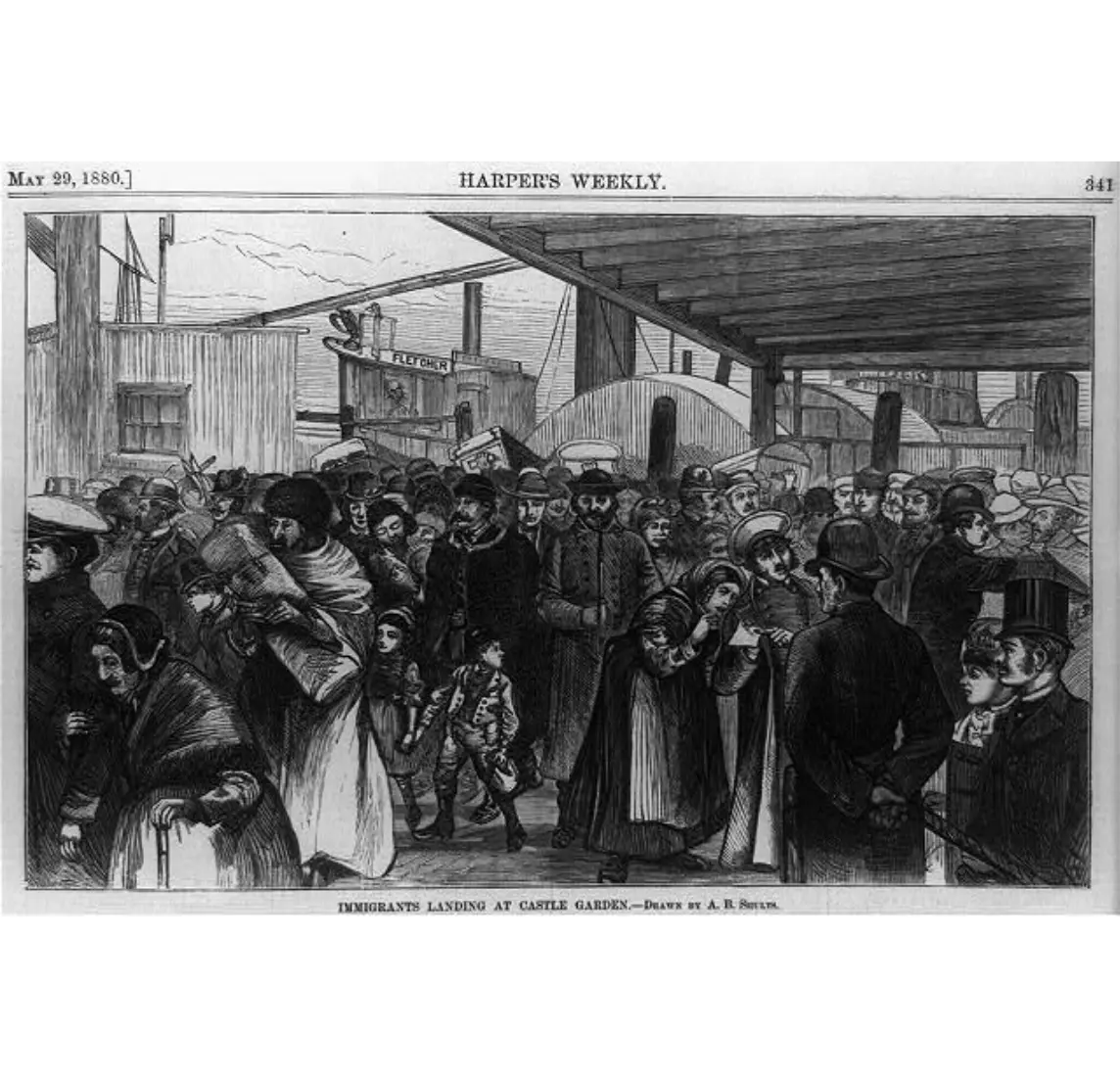
New York City and its port appear in 70 of the 199 family group entries — still by far the most frequently mentioned American location in the entire database, and growing faster than the dataset itself. This reflects the enduring dominance of New York as the primary American immigration port, particularly after the opening of Castle Garden in 1855 and Ellis Island in 1892.[3] But the New York entries in the database are still not uniformly “New York settlers.” Many families arrived in New York and moved on immediately, with the port serving as a transit point rather than a final destination. Others stayed — particularly in Brooklyn, which appears 5 times as a specific settlement location, often for families involved in trades such as wine importing, cigar manufacturing, and paperhanging.
The Inland Spread: Pennsylvania, the Midwest, and Beyond
After New York, the geographic settlement pattern in the database continues to reflect the westward expansion of the nineteenth century with considerable precision.
Pennsylvania (14 groups documenting primary settlement there) was both an early destination — several family groups from the colonial period settled in German Pennsylvania communities in Lancaster, York, and Dauphin counties, joined now by a newly documented colonial arrival, Group 171, landing in Philadelphia in 1755 — and a transit state for families moving further west. Philadelphia appears 16 times in the database and continues to serve as both a destination and a jumping-off point for families heading into the interior.
The Midwest remains where the greatest concentration of Dillman families ultimately settled. Ohio (10 groups), Missouri (9), Illinois (8), Wisconsin (7), Indiana (5), and Minnesota (2) all appear with meaningful frequency. The pattern follows the same logic of nineteenth-century Midwestern settlement the original survey identified: German immigrants moved west along established routes, often following chains of earlier arrivals from the same home region.
St. Louis (8 groups) remains the most frequently mentioned inland city in the database by name, serving as a hub for German Catholic immigration from the 1840s onward and appearing as a destination for multiple Dillman family groups from Hesse, the Rhineland, and Bavaria — none of them apparently connected to each other, but all drawn to the same city by its reputation as a German-speaking community with economic opportunity.
Chicago (9 mentions) and Milwaukee (5) reflect the later wave of German immigration in the 1870s and 1880s, when the upper Midwest was absorbing large numbers of German settlers attracted by available agricultural land and established German-speaking communities.
California (11 groups, now the second most common state after New York, ahead of Pennsylvania) and San Francisco (7 mentions) appear with a frequency that continues to surprise researchers who associate Dillman families primarily with the Midwest. The California entries include multiple French-origin Delmon families who settled in San Francisco from the mid-nineteenth century onward, as well as German Dillmanns and, among the newly added groups, families who arrived via a period in Canada before continuing to the Pacific coast.
The Immigration Timeline
The database documents immigration events across more than two centuries, and the decade-by-decade pattern continues to reveal the broader rhythms of German emigration to America — now with one addition worth noting on its own.
The earliest groups — a handful of families arriving in the 1630s through 1770s, nine in total — represent the colonial-era German immigration to Pennsylvania that predates the United States itself, including the newly documented Group 171. These remain the oldest Dillman lines in America.
The major nineteenth-century wave began in the 1840s and ran through the 1850s (15 and 17 documented groups respectively), corresponding to the political upheaval of 1848 and the economic conditions that drove mass emigration from the German states. The pace slowed in the 1860s and 1870s (9 and 6 groups) — partly due to the American Civil War deterring immigration — before accelerating again sharply in the 1880s (20 groups), still the single largest decade of German immigration in the dataset. The 1900s and 1910s (19 and 13 groups) represent a second major wave, this one dominated by the Russian-German Volga colonists fleeing conscription rather than the earlier southwestern German emigration.
The one real change: the original survey found no documented arrivals between 1930 and 1945. Two family groups now fill that gap — an Anschluss-era refugee family from Vienna and a merchant seaman documented as “definitively residing in the US” by 1942 — a small but genuine correction to what had been reported as a complete wartime gap. The post-war period, 1946 onward, accounts for 10 documented groups.
Beyond the United States
Not all Dillman families went to the United States, and the database documents this diversity clearly. Canada (18 groups with a documented connection, 14 of them representing genuine long-term settlement rather than a brief transit stop) remains the second most common destination overall — some families arriving directly, others migrating north from American communities after initial settlement, and a Volga-Saratov cluster settling the Canadian prairie provinces for reasons identical to their cousins who chose the American Midwest instead. Australia (4 groups, up from 2), Brazil (2), Mexico (2), Panama (2), and South Africa (1) round out the database’s genuinely global reach, reflecting the same emigration pressures — economic hardship, religious conflict, political upheaval — playing out across continents rather than just across the Atlantic. Several family groups document families that moved through multiple countries before reaching their final destination, with the geographic coverage fields tracing paths that span decades and continents.
A Map of Movement
What the expanded database shows, taken as a whole, is still not a single Dillman migration but dozens of overlapping ones: families from the same Rhenish village arriving at the same New York pier in the same decade, knowing nothing of each other; families from distant Hessian towns converging on the same St. Louis neighborhood for reasons that had everything to do with the shape of nineteenth-century immigration networks and nothing to do with family connection. The surname linked them on paper; the geography explains why they ended up where they did.
For researchers tracing a specific Dillman line, this settlement map still offers a practical guide: if your ancestor arrived in the 1850s and settled in the Midwest, look to Baden or Hesse for origins. If the family appears in California before 1880, consider Alsatian or French connections. If the line runs through Pennsylvania to the colonial period, the DFA’s oldest family groups — and the dense genealogical records of German Pennsylvania — are where the search should focus. And if a line seems to vanish between 1930 and 1945, it’s no longer safe to assume the family simply didn’t emigrate during that window; check the specific circumstances before concluding the record is silent.
The Dillman families spread across a continent and, in some cases, across several continents. Thirty-nine additional family groups have only sharpened that picture — the database makes it possible to see the full shape of that dispersal with more precision than before, not a different shape entirely.
Sources
- “Germany Empire and Current States,” FamilySearch Research Wiki (accessed July 2026), used to map historical German states and provinces to the cities and towns named in the DFA’s Family Group Fact Sheets.
- “German Genealogy — Emigration Records,” genealoger.com (accessed July 2026).
- “Overview + History,” Statue of Liberty-Ellis Island Foundation (accessed July 2026).
Notes
- All family group data cited in this article is drawn from the Dillman Family Association, Family Group Sheet Database, compiled 2026; internal database, Dillman Family Association. Individual family group sheets are numbered and held by the DFA.
- Shults, A. B., Artist. Immigrants landing at Castle Garden / drawn by A.B. Shults. United States, New York, 1880. Photograph. Library of Congress Prints and Photographs Division. https://www.loc.gov/item/90707732/. Featured image.
- OwenBlacker. “Alsace Lorraine Departments Evolution Map.” Wikimedia Commons. CC BY-SA 4.0. commons.wikimedia.org. Inline image, “The Alsatian Borderland” section.
Discover more from Dillman Family Association
Subscribe to get the latest posts sent to your email.