
Data drawn from Dillman Family Association Family Group Fact Sheets and published historical sources. This article covers families documented in the first 94 groups; additional reverse migration stories may emerge from the remaining groups.
The history of German immigration to the United States is usually told in one direction — west across the Atlantic, from the old country to the new. Between roughly 1820 and 1920, some six million people made that journey, most of them intending never to return. But the story is not as linear as it appears. A significant minority of German immigrants went back. Some had always intended to. Some were compelled by circumstance. Some came only for months and were never immigrants at all in any meaningful sense. And a few spent their lives moving back and forth across the Atlantic, leaving descendants on both sides who lost track of one another across the generations.
The Dillman Family Association’s Family Group Fact Sheets document several such cases among the first 94 family groups — stories that complicate the standard immigration narrative and reveal just how fluid the movement between the Old World and the New could be. This article examines those stories: a man born in America who chose Germany; a family line that crossed the Atlantic twice in two generations; a woman who went home and stayed; a soldier who emigrated and then went back to fight; and a French engineer who passed through America in January 1926 and was home in time for spring.
The Scale of Return Migration
The phenomenon of return migration from the United States to Germany was substantial enough to attract the attention of the United States Department of State in the 1870s. In 1873, the American minister to Germany reported to Washington that some 10,672 Americans were present in Germany — a number that included both native-born Americans and naturalized German immigrants who had returned. He estimated that approximately 15,000 Americans arrived in Germany each year, of whom about 13,000 returned to the United States in the same season, leaving roughly 1,500 sojourning for longer periods and about 500 per year who appeared to be settling indefinitely.[1]
Crucially, the minister noted that at least three-quarters of those Americans residing permanently or indefinitely in Germany were persons of German birth who had naturalized in the United States and then returned to their homeland — precisely the category to which several of the Dillman family cases belong. The traffic across the Atlantic, in other words, moved in both directions throughout the 19th and early 20th centuries, and the Dillman family groups provide individual human faces for what the diplomatic dispatches recorded only as statistics.
🔄 Born in New York, Buried in Berlin: Bruno Adolf Dillmann

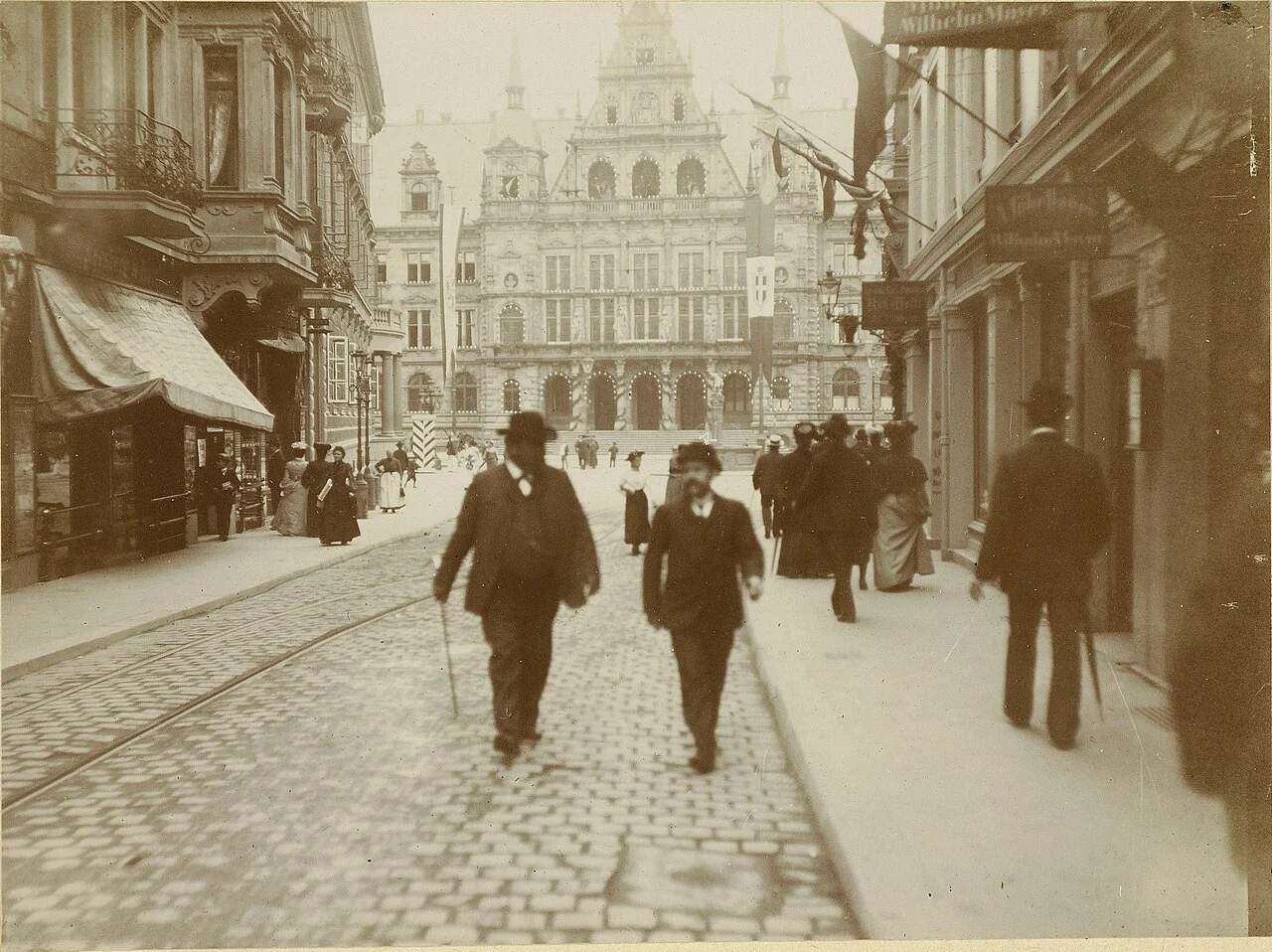
Emperor William Memorial, Berlin, c. 1900. Bruno Adolf Dillmann (Group 38) emigrated from New York to Berlin in 1884 and died there in 1913. Photographed c. 1900; from Janos Frecot & Helmut Geisert, Berlin in frühen Photographien 1857–1913 (Schirmer/Mosel, 1984). Public domain.
The most striking reversal in the documented Dillman groups belongs to Group 38 — a man who did not return to Germany but emigrated there, because Germany was never where he came from.
Bruno Adolf Dillmann was born in New York in 1859, the son of German immigrants. He was, by birth, an American. Yet in 1884, at the age of approximately 25, he boarded a ship heading east across the Atlantic and emigrated to Germany — the country his parents had left a generation before. He settled in Berlin and worked as a brewer, one of the trades in which German immigrants and their descendants were concentrated throughout the 19th century. He married, had daughters, and built his life there. He died in Berlin in 1913, having spent nearly three decades as an American citizen living permanently in Germany.
The story does not end there. After Bruno’s death, his widow and daughter used his American citizenship to return to the United States in 1915 — just as World War I was making life increasingly difficult for families with transatlantic connections. The circle closed: the son of German immigrants had gone to Germany; his widow returned to America. The family had made a complete round trip across two generations, ending where it began.[2]
Two Generations, One Round Trip: The Georg Martin Dillmann Line
Group 94 documents one of the longest-spanning circular migrations in the entire DFA dataset — a family story that stretches across nearly a century and two Atlantic crossings.

SS Imperator, Hamburg-America Line, launched 1912. Ships like the Imperator carried both emigrants and returnees across the Atlantic. Library of Congress, George Grantham Bain Collection. No known restrictions on publication.
Georg Martin Dillmann arrived in America in 1759, according to the Eighteenth Century Register of Emigrants from Southwest Germany to America and Other Countries compiled by Werner Hacker.[3] He came from Gondelsheim in Baden, Germany, and settled in New York. But the Family Group Fact Sheet records something unusual: Georg Martin may have returned to Germany, married there, and raised a family in the old country. The evidence is indirect but compelling — a Johann Michael Dillmann appears in the German records as Georg Martin’s son, and Johann Michael’s own son, Christof, emigrated to New York in October 1847 with his wife and seven children.
If the reconstruction is correct, the pattern is extraordinary: Georg Martin crossed the Atlantic to America in 1759, apparently returned to Germany, and his grandson Christof made the same crossing again in 1847 — 88 years later, with a family of nine. Christof was buried in Mount Hope Cemetery, Rochester, New York, in 1878, having spent the last decades of his life in the country his grandfather had first reached before the American Revolution. The round trip took nearly a century to complete, and required three generations to come full circle.[4]
She Went Home and Stayed: Josefina Dillmann
Group 12 — the Geisenheim Dillmanns of the Rheingau, one of the oldest and most extensively documented lines in the DFA records — includes the story of Josefina Elisabetha Dillmann, who made the crossing to America and then simply turned around and went home.
Josefina sailed from Antwerp to New York in 1902, one of the millions who made that journey in the peak years of European immigration to the United States. Whatever she found when she arrived did not hold her. By 1905 she was back in Germany, married in Wiesbaden. She lived out the remainder of her life there, dying in December 1948 — having survived, in Germany, the entirety of both World Wars, the Weimar Republic, the Third Reich, and the postwar occupation. Her American episode lasted perhaps two or three years. Her German life lasted the remaining four decades.[5]
Josefina’s story is a reminder that not every immigrant who arrived at Ellis Island intended to stay. The conventional picture of the immigrant making a clean break with the old country, planting roots in American soil, and never looking back was true for many — but not for all. For some, America was a chapter rather than a destination.
He Went Back to Fight: Gustav Dillmann
Group 34 documents a case that was not uncommon in the years before the First World War but has been largely forgotten: the story of a German immigrant who returned to his country of origin to serve in its military.
Gustav Dillmann emigrated from Germany to New York in 1897, making the crossing together with his cousin Adam. He settled in the United States, working and building a life in New York. But when World War I began in 1914, Gustav returned to Germany and served in the Bavarian Army — fighting, ultimately, against the country he had lived in as an immigrant.[6]
This situation was far from unique. German-born men who had emigrated to the United States but retained German citizenship faced enormous pressure — and in many cases legal obligation — to return and serve when war broke out. Those who had naturalized as American citizens were legally exempt, but naturalization was a lengthy process, and many who had been in the United States for only a few years had not completed it. Others returned voluntarily, drawn by loyalty to the country of their birth. The dual allegiance that had made the German-American community a celebrated bridge between two cultures suddenly became a source of suspicion on both sides of the Atlantic.
A Citroën Engineer in New York: André Georges Dielmann
Not every reverse migration in the family group records involves drama or displacement. Group 48 documents the most mundane variety of transatlantic movement — a business trip.

A Citroën 5HP delivery vehicle, 1923. André Georges Dielmann (Group 48) was a Citroën engineer who visited the USA in January 1926 as part of the company’s international expansion. Public domain.
André Georges Dielmann was an engineer employed by Citroën, the French automobile manufacturer founded in 1919 by André-Gustave Citroën.[7] André Georges arrived in the United States in January 1926 for a four-month stay, traveling on business, and returned to France when his assignment was complete. He never intended to immigrate. He appears in the American records only because his passage was documented, as all passenger arrivals were, by port authorities.
The timing places his visit squarely in one of the most significant years in Citroën’s early history. By 1926, Citroën was establishing international subsidiaries and assembly operations in Belgium, the United Kingdom, Italy, and Japan, becoming Europe’s largest car manufacturer within eight years of its founding.[8] A company engineer sent to the United States in January 1926 was almost certainly part of that expansionary push — examining American manufacturing methods, scouting suppliers, or building the commercial relationships that would support international growth. André-Gustave Citroën himself had made a fact-finding trip to Henry Ford’s factories in 1912, which had shaped Citroën’s entire approach to mass production.[9] André Georges Dielmann’s four-month American sojourn left no permanent trace in the United States. But it places a member of a Dillman family line at the intersection of French industrial ambition and American manufacturing know-how in exactly the moment when European automakers were learning from Detroit how to build cars for everyone.
The Reluctant American: Anton Dillmann of Munich
Group 71 documents another visitor rather than a settler. Dr. Anton Dillmann of Munich visited New York in July 1934, traveling alone, having left his wife in Munich. The Family Group Fact Sheet records that he was likely on a study trip — a professional or academic visit of the kind common among European scholars and professionals in the interwar period.
Anton had served in the 2nd Bavarian Infantry Regiment during World War I, married in Berlin in 1918, and by 1920 was established in a Munich city directory. His 1934 visit to New York was a late-career sojourn, made at a moment when Germany was in its second year under National Socialist rule and the professional and intellectual world was already experiencing the upheaval that would drive so many German scholars into permanent exile. Anton was not among those who stayed. He returned to Munich, to his wife, to the city he had lived in for a decade and a half. What he saw in New York in the summer of 1934 — and what, if anything, it made him think about the Germany he was returning to — the family records do not say.[10]
What the Round Trips Tell Us
Taken together, these stories reveal that the Atlantic crossing was never a one-way gate. It was a door that swung both ways — slowly in the age of sail, quickly in the age of steam, almost effortlessly by the 1920s when an engineer could cross for a business trip and be home in four months. The people who went back did so for reasons as varied as the people who stayed: Bruno Adolf Dillmann because Germany was his chosen home; Josefina Dillmann because America did not hold her; Gustav Dillmann because a war called him; Georg Martin Dillmann because the records are silent on why, and only his grandson’s westward crossing a century later suggests what may have happened.
The conventional immigration story — leave the old country, arrive in the new, never look back — was always an oversimplification. The families who appear in the DFA’s records were not simply moving from one fixed point to another. They were navigating between two worlds, sometimes across multiple generations, sometimes within a single lifetime, sometimes within a single year. The ones who went back are a reminder that migration is rarely as simple, or as permanent, as it looks from the outside.
The remaining Dillman family groups — extending through Group 163 — will likely yield additional examples of reverse and circular migration. A follow-up article will examine the complete dataset when that data has been compiled.
The Dillman Family Association’s Family Group Fact Sheets are available to members at dillmanfamilyassociation.org. Researchers with additional information about return migrations in their Dillman family lines are encouraged to contact the DFA to contribute to future updates.
Sources
- United States Department of State, “Mr. Bancroft to Mr. Fish,” Berlin, September 8, 1873, in Papers Relating to the Foreign Relations of the United States, 1873, history.state.gov (accessed June 2026); “Mr. Davis to Mr. Fish,” Berlin, November 2, 1874, history.state.gov (accessed June 2026).
- Dillman Family Association, Family Group Fact Sheet, Group 38 — Bruno Adolf Dillmann of New York and Germany (2021), dillmanfamilyassociation.org.
- Werner Hacker, Eighteenth Century Register of Emigrants from Southwest Germany to America and Other Countries (Neustadt an der Weinstraße: Degener, 1983); cited in DFA Family Group Fact Sheet, Group 94.
- Dillman Family Association, Family Group Fact Sheet, Group 94 — Georg Martin Dillmann of New York and Gondelsheim, Baden (2021), dillmanfamilyassociation.org.
- Dillman Family Association, Family Group Fact Sheet, Group 12 — Josefina Elisabetha Dillmann of Geisenheim, Rhineland (2021), dillmanfamilyassociation.org.
- Dillman Family Association, Family Group Fact Sheet, Group 34 — Gustav Dillmann of New York and Bavaria (2021), dillmanfamilyassociation.org.
- Dillman Family Association, Family Group Fact Sheet, Group 48 — André Georges Dielmann, Citroën Engineer (2021), dillmanfamilyassociation.org.
- Wikipedia, “Citroën,” en.wikipedia.org/wiki/Citroën (accessed June 2026); Laventure Association, “Citroën: An Exceptional Man and a Century-Old Brand,” laventure-association.com (accessed June 2026).
- EBSCO Research Starters, “André-Gustave Citroën,” ebsco.com (accessed June 2026).
- Dillman Family Association, Family Group Fact Sheet, Group 71 — Franz Xavier Dilmann of Aschaffenburg, Bavaria (2021), dillmanfamilyassociation.org.
AI Disclosure: This article was researched and written with the assistance of Claude, an AI assistant developed by Anthropic. Historical facts about specific individuals have been verified against primary sources and published references. Information about DFA Family Groups is drawn from the Dillman Family Association’s Family Group Fact Sheets.
Discover more from Dillman Family Association
Subscribe to get the latest posts sent to your email.