
Six separate Dillmann family groups trace their earliest known ancestor to one of two villages, three miles apart, on the west bank of the Volga River. Not to Russia. Not even to Saratov province, the administrative region that contained them. To Norka, and to the daughter colony its own overflow population founded a few miles downstream: New Norka. Nowhere else in the DFA’s Family Group Sheet database do two neighboring villages account for so large a share of the group total — and nowhere else does the state-level view this series has already mapped hide quite so much.
The Limits of the State Map
The “Where They Went” pieces in this series have already done the work of mapping the Dillman family groups to the German states and historical provinces their ancestors left — Hesse, Rhineland-Palatinate, Baden, and the rest. That level of detail is genuinely useful. It is also, for most of the 200 Family Group Sheets now in the database, as far as the record goes: a sheet that says “Germany,” or even “Hesse, Germany,” names a state roughly the size of New Jersey and stops there.
Only 76 of those 200 sheets — fewer than two in five — go one step further and name an actual town, village, or parish for the family’s earliest known ancestor. This article is about those 76. It doesn’t repeat the state-level totals already published; it asks a narrower and, for working researchers, often more useful question: when a sheet does name a specific place, what does that place turn out to be, and what does it tell us that “Germany” alone cannot?
A Duchy That Isn’t on Any Map

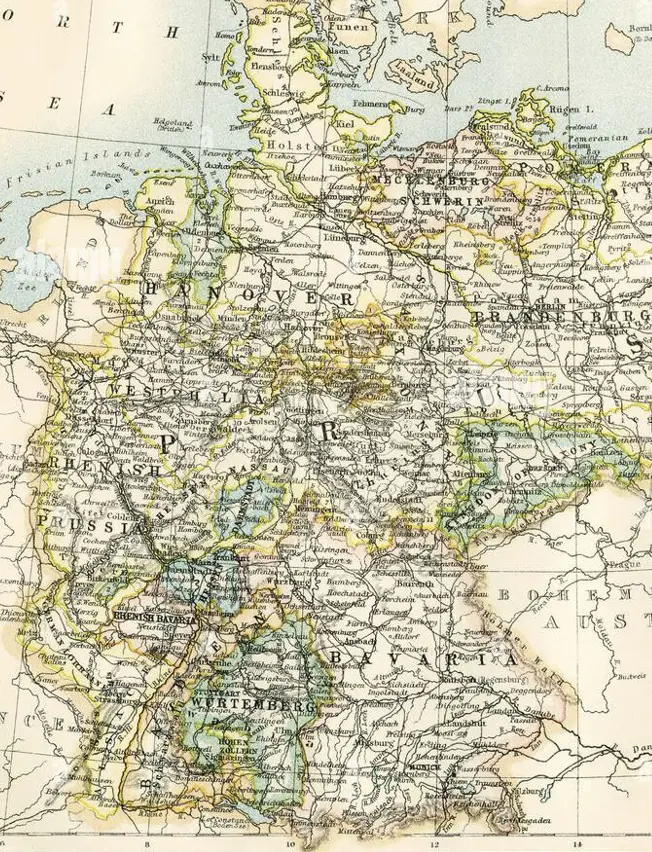
Ten of the 76 town-naming groups trace their origin to “Nassau, Germany.” A researcher searching a modern map for Nassau will not find it, because it has not been a place you could govern, tax, or draft soldiers from since 1866. The Duchy of Nassau was an independent sovereign state within the German Confederation until it backed Austria in that year’s war with Prussia — the losing side. Prussia annexed the duchy outright and folded its territory into the new Province of Hesse-Nassau, straddling what is today the border between Hesse and Rhineland-Palatinate.[1] The sheets that simply say “Nassau, Germany” are, in effect, citing a government that stopped existing just after the end of the American Civil War.
Where the sheets go further, they name specific towns scattered across the old duchy: Hellenhahn, home to brothers J.C. and Johann Peter Dielmann (Group 23); Niederbuchen, where Joseph Dillmann’s line began (Group 27); Obertiefenbach, origin point for Jakob Dillmann, who settled in Chicago (Group 90); and Schellenberg, birthplace of Wilhelm Dillmann (Group 25). The duchy’s capital, Wiesbaden, appears elsewhere in this series — it’s where Josefina Dillmann of Group 12 returned in 1905 to marry and spend the rest of her life, a story told in “Going Back.” For a family researcher, the practical consequence of all this is real: a sheet that stops at “Nassau, Germany” is pointing not toward a present-day state archive but toward the duchy’s own 19th-century civil and church registers — a different, narrower search than “Hesse” would suggest.
Two Villages, Six Families: The Volga Cluster
Norka was founded in 1767 by German colonists who answered Catherine the Great’s invitation to settle the Volga frontier — one of more than a hundred such colonies planted along the river in the years after 1764.[2] New Norka is documented as one of Norka’s daughter colonies, founded later by settlers from the original village, though the surviving records do not say exactly when or why the second village was established.[2] The two villages sat close enough that, from an ocean and a century away, the Family Group Sheets sometimes render them almost interchangeably: “Norka, Russia,” “Norka, Saratov, Russia,” “New Norka, Saratov, Russia.”
Six documented groups trace to this pair of villages, and the sheets record no family connection between most of them: Johann Dillmann (Group 15), Heinrich Dillmann (Group 50), John Dillmann (Group 53), Frederick Dillmann (Group 54), Peter Dillmann (Group 58), and Henry Louis Dillman — sometimes recorded as Dilliman (Group 87). That six independently-documented lines converge on two villages that most maps don’t bother to label is the single tightest geographic concentration anywhere in the database — tighter than any two towns in the German homeland itself. It is also, for descendants of any of these six groups, an unusually well-defined research target: where a Baden or Hesse researcher might need to guess among dozens of possible parishes, a Norka researcher already knows which two to ask for.
One Duchy, Seven Villages: The Baden Pattern
Baden tells a related but messier story. Nine documented groups trace to the Grand Duchy of Baden; eight of them name a town, though only seven distinct towns turn up among them — one repeats.[3] Johannes Adam Tillman’s line begins in Ettlingen (Group 14). Karl G. Dihlmann’s people came from Tüllingen (Group 47). Georg Martin Dillmann — whose own remarkable back-and-forth across the Atlantic is told elsewhere in this series — traces to Gondelsheim (Group 94).[4] Philipp Dillmann’s family left Langensteinbach (Group 95); Jakob Sillmann’s, Reichenbach (Group 115); Thomas Dillmann’s, Haltingen (Group 143); Georg Adam Dillmann’s, Spielberg (Group 145). A ninth group, Antony Dillmann’s (Group 162), names only “Baden, Germany,” with no town recorded at all. The eighth town-naming sheet, Group 188, looked at first like a similar gap: it gives Henry Dillmann’s origin as “Langenstenbach” in one field and “Karlsruhe” in another. But Langensteinbach — almost certainly the place the sheet’s misspelling intends — is a village now part of Karlsbad, a much smaller town about 13 kilometers southeast of Karlsruhe.[6] Henry Dillmann’s sheet likely names Karlsruhe simply as the nearest larger, better-known city, not a second, competing origin. That also makes Group 188 the same town as Philipp Dillmann’s Group 95 — the one repeat among Baden’s named villages.
Set against Norka’s two villages and six families, Baden’s nine groups spread across seven different towns still look like a genuinely different settlement geography, not just a smaller sample of the same pattern. Baden sent emigrants from many scattered small towns rather than a handful of hubs — consistent with the broader picture of Baden emigration research, which describes a duchy of many market towns and villages rather than one or two dominant sources of departure.[5]
Frankfurt, Four Times
Among named cities, only one repeats entirely on its own, outside any duchy-level story: Frankfurt, home city to four separate, apparently unconnected groups — Ludwig Wilhelm Dielmann’s line (Group 22), Heinrich Dielmann’s (Group 62), Peter Dillmann’s (Group 111), and Anna Katharina Dillmann’s (Group 146). Frankfurt’s free imperial city status gave it centuries of well-kept, well-preserved municipal and church records, so its repeat appearances in the database may say as much about which records survived to be searched as about how many Dillmanns actually lived there relative to anywhere else. That caveat applies, to some degree, to every count in this article: a town appears here because a sheet happened to record it, not because the database has confirmed it is the only or the true origin point for every branch of that line.
What the Village Remembers
The state-level view this series has already published tells a researcher which German state to search. The village-level view, where it exists, tells them which parish register to actually request — a different and often more actionable piece of information. The trouble is that only 76 of 200 documented groups currently support that second, sharper kind of answer. The other 124 have real families behind them, and in most cases real towns behind those families, waiting on a fact sheet that hasn’t yet been updated with the detail a descendant somewhere may already hold.
That is, in the end, an invitation as much as a finding. Any member whose own family group sheet currently stops at “Germany,” or names only a state, and who holds a more specific place name in their own research, is in a position to close part of that gap directly. Six families already know they come from one of two villages on the Volga. A hundred and twenty-four groups’ worth of families are still waiting to learn theirs.
Sources
- “Duchy of Nassau.” Wikipedia. Accessed September 2026. en.wikipedia.org/wiki/Duchy_of_Nassau.
- “Norka.” Volga German Institute. Accessed September 2026. volgagermaninstitute.org/colonies/norka.
- Dillman Family Association, Family Group Sheet Database, compiled 2026; internal database, Dillman Family Association. Individual family group sheets are numbered and held by the DFA.
- “Going Back: Return Migration in the Dillman Families.” Dillman Family Association. June 2026. dillmanfamilyassociation.org.
- Library of Congress, European Reading Room. “Baden-Württemberg.” German Origins in the United States: A Guide to Local History and Genealogy Sources. Accessed September 2026. guides.loc.gov; “Baden Emigration and Immigration.” FamilySearch Research Wiki. Accessed September 2026. familysearch.org.
- “Karlsbad (Baden).” Wikipedia. Accessed September 2026. en.wikipedia.org/wiki/Karlsbad_(Baden).
- Wiesbaden, Germany, photographed by Julius Gujer, c. 1904–1905. Public domain, via Wikimedia Commons. Featured and inline image, “A Duchy That Isn’t on Any Map” section.
AI Disclosure: This article was researched and written with the assistance of Claude, an AI assistant developed by Anthropic. Family group data is drawn directly from the Dillman Family Association’s Family Group Sheet Database; historical context on the Duchy of Nassau, the Volga German colonies, and Baden emigration patterns has been verified against the published sources cited above.
Discover more from Dillman Family Association
Subscribe to get the latest posts sent to your email.