
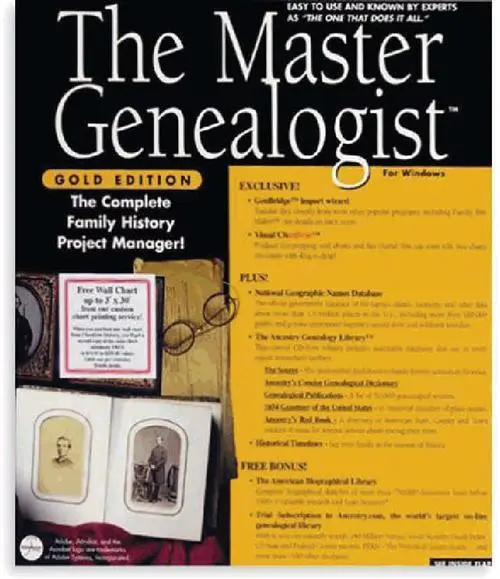
Some software is best understood by the hole it left behind. The Master Genealogist — known to its community as TMG — was discontinued in 2014 after more than two decades of development, and a significant number of genealogists are still using it today. That fact alone says something remarkable about the program: that twelve years after its final release, researchers who know what TMG could do have found nothing that does the same things as well.
Understanding TMG matters for two reasons: first, because there are almost certainly DFA members with years of family research locked in TMG databases who face a real decision about what to do with that data; and second, because TMG’s approach to genealogical evidence set a standard that continues to influence what serious researchers expect from their software — and usually don’t find.
What TMG Was
The Master Genealogist was genealogy software originally created by Bob Velke for Microsoft DOS in 1993, with a Windows version released in 1996. Official support ceased at the end of 2014. The final release was version 9.05.0000, released on December 3, 2014.
Bob Velke, president of Wholly Genes Software, announced the discontinuation on July 29, 2014: “I am sad to report that the decision has been made to discontinue The Master Genealogist. While thousands of TMG users appreciate the program’s many powerful features that are unmatched in other software, the market for those advanced features has proved to be insufficient to support the infrastructure that is necessary to support it and continue development.”
The announcement was handled with uncommon transparency. Sales continued through September 2014, official support ended December 31, 2014, and user-to-user forums remained available. Informal support continues today through a number of online user groups.
What Made TMG Different
TMG was not simply a more capable version of what other genealogy programs were doing. It operated from a fundamentally different philosophy about what genealogical data management should look like, and that philosophy produced capabilities that remain unmatched in any current commercial product.
Evidence-based source citations. The default source types in TMG’s standard edition were based on Wholly Genes’ interpretation of Elizabeth Shown Mills’ Evidence! Citation and Analysis for the Family Historian. TMG was built around the idea that a genealogical database should not just store facts — it should store evidence: where the fact came from, what kind of source that was, how reliable the researcher judged it to be, and how it compared to conflicting evidence from other sources. This is precisely the standard that Evidence Explained codified, and TMG implemented it at the software level. No current mainstream genealogy program has fully replicated this.
Surety ratings. TMG allowed researchers to assign a “surety” value to any piece of evidence — a numerical rating indicating the researcher’s confidence in that specific piece of information. This made it possible to flag uncertain conclusions at the data level rather than having to track uncertainty in separate notes.
Roles and witnesses. Standard genealogy software records events (a marriage, a census entry) and the principals involved. TMG went further, allowing any number of participants in an event to be recorded with specific roles. The same 1880 census entry could record a husband as head of household, a wife as spouse, children in their ages, and a boarder as a lodger — each linked to the same event, each with their own sentence output. This approach captured the relational context of records in a way that flat event/person data structures cannot.
Customizable event types. Researchers could define their own event types — not just the standard birth/marriage/death set, but apprenticeship records, land grants, military muster entries, probate filings, or any other record type a specific research project required.
GenBridge importing. TMG’s GenBridge recognized many common genealogy data formats and imported genealogical data directly, minimizing the loss of data that GEDCOM transfers typically produce. This was particularly important for researchers migrating from other programs, as GEDCOM’s limitations often result in significant data loss.
The TMG User in 2026
A researcher still using TMG in 2026 is almost certainly running it on Windows — TMG was written in Visual FoxPro and ran on Windows 95 and later — and doing so because the data they have accumulated over years or decades represents a research investment they are reluctant to lose in a migration. Their concern is legitimate: GEDCOM does not capture everything TMG stores, and migrating a complex TMG database through GEDCOM means accepting data loss.
The best current migration path is RootsMagic. RootsMagic offers a direct TMG import that goes beyond GEDCOM, preserving witnesses, roles, source templates, and other TMG-specific data that a standard GEDCOM export would discard. This does not capture everything — some TMG-specific structures do not have direct equivalents in RootsMagic — but it is considerably better than the alternative.
Second Site (developed by John Cardinal) remains actively maintained and allows TMG users to generate well-formatted websites from their TMG data. For researchers who want to publish their research without migrating, Second Site provides a practical path.
History Research Environment (HRE) is a long-in-development open-source project explicitly designed as a spiritual successor to TMG. HRE is designed to provide an onward path for genealogists who currently use the discontinued TMG, with the ability to import existing TMG projects without data loss. Development has proceeded slowly, and fully operational software is not yet available — but it represents the most ambitious attempt to capture what TMG offered and bring it forward.
What TMG Means for Standards
Even for researchers who never used TMG, the program’s legacy matters. The Evidence Explained citation framework that TMG implemented — and that the DFA now uses as its editorial standard — reflects the same conviction that drove TMG’s design: that genealogical research is evidence-based, that sources must be cited precisely, and that the level of confidence in any conclusion should be explicit rather than assumed.
TMG demonstrated that this approach was achievable in software. The tools that eventually replace it will need to demonstrate the same thing.
Sources
Velke, Bob. “Discontinuation Announcement.” Wholly Genes Software. July 29, 2014. Archived at tmg.reigelridge.com/future.htm.
“The Master Genealogist.” Wikipedia. Accessed July 2026. en.wikipedia.org/wiki/The_Master_Genealogist.
RootsMagic. “TMG Upgrade.” RootsMagic. Accessed July 2026. rootsmagic.com/tmg.
History Research Environment. “HRE for Users of The Master Genealogist.” Accessed July 2026. historyresearchenvironment.org.
Note: This post was researched and written with the assistance of artificial intelligence (AI). All content has been reviewed for accuracy as of August 2026. All errors are the responsibility of the author.
Discover more from Dillman Family Association
Subscribe to get the latest posts sent to your email.