
Sources
- FamilySearch, “Personal Ancestral File,” familysearch.org/en/wiki/Personal_Ancestral_File (accessed May 2026).
- Wikipedia, “Personal Ancestral File,” en.wikipedia.org/wiki/Personal_Ancestral_File (accessed May 2026).
- Incline Software, “Ancestral Quest History,” ancquest.com (accessed May 2026).
- FamilySearch, “PAF Discontinuation Notice,” June 2013, familysearch.org (accessed May 2026).
- Wikipedia, “Personal Ancestral File — Distribution,” en.wikipedia.org/wiki/Personal_Ancestral_File (accessed May 2026).
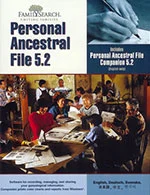
Image: Personal Ancestral File (PAF) version 5 product shot — © FamilySearch / The Church of Jesus Christ of Latter-day Saints. Used for editorial and historical reference purposes.
Before Family Tree Maker. Before RootsMagic. Before Legacy Family Tree. Before any of the genealogy software platforms that serious researchers use today — there was Personal Ancestral File (PAF). Released in April 1984 by the Genealogical Department of The Church of Jesus Christ of Latter-day Saints (LDS), PAF was not merely one of the first consumer genealogy applications. For a generation of researchers, it was genealogy software — the program that introduced millions of people to the concept of maintaining a family tree on a computer, and the platform whose development drove the creation of the Genealogical Data Communication (GEDCOM) standard that still underpins data exchange across the entire industry today.
PAF was officially discontinued on July 15, 2013, after nearly three decades and more than 3.2 million copies distributed. But its influence endures in ways most genealogists don’t fully appreciate — embedded in the software they use today, in the data exchange standards they rely on, and in the research habits of an entire generation of family historians. This is its story.
Origins: Six Floppy Disks and a Vision
The story of PAF begins in the early 1980s, when the Genealogical Department of the LDS Church recognized that the emerging personal computer market represented a transformative opportunity for family history research. The Church had long been the world’s most committed institutional practitioner of genealogical research — its theological interest in the sealing of families across generations drove an unparalleled effort to collect, microfilm, and index historical records from around the world. Putting a genealogy tool into the hands of ordinary members on their home computers was a natural extension of that mission.
PAF 1.0 was released in April 1984[1], written in Microsoft BASIC for the IBM Personal Computer (IBM PC) and requiring MS-DOS 1.1 or later. The original package consisted of six floppy disks and a printed manual, available by mail order for $35[2] — a price point that, for its time, was deliberately accessible. An LDS Church news release promoted it as “a powerful tool, a sophisticated yet easy-to-use system for simplifying genealogical record-keeping,” claiming that “information retrieval is fast and easy.” Those early claims were somewhat optimistic — PAF 1.0, written in BASIC, was notably slow — but the vision was sound. The Church announced plans to develop versions for the TRS-80 III and Apple II+ computers, signaling its ambition to reach the broadest possible audience.
PAF’s arrival predated Family Tree Maker by five years and preceded most of the genealogy software landscape that followed. The only earlier computer genealogy application of note was a Microsoft BASIC program for the TRS-80 called Genealogy: Compiling Roots and Branches, published in the September 1979 issue of Personal Computing Magazine — a hobbyist program, not a commercial product. PAF was the first serious, purposefully distributed genealogy application, and its institutional backing gave it reach and longevity that no individual developer could have matched.
The Version History: A Software Evolution
PAF 1.0 (April 1984) — The original release, written in BASIC for MS-DOS. Six floppy disks, $35 by mail order. Functional but slow, and without GEDCOM support — the standard hadn’t been created yet. No support for Apple or CP/M systems despite early announcements.
PAF 2.0 (April 1986) — A complete rewrite in the C programming language, delivering a dramatic speed improvement over the BASIC original. Available for MS-DOS, CP/M, and Apple II computers — the multiplatform release that earlier versions had promised. PAF 2.0 introduced GEDCOM support, implementing GEDCOM 2.0 as the Church simultaneously developed the standard. This is the version where PAF’s development and GEDCOM’s development became explicitly intertwined: successive GEDCOM versions 2.1, 2.2, and 2.3 correspond directly to PAF releases of the same minor version numbers during the late 1980s.
PAF 2.3.1 (1994) — The last version developed specifically for the Macintosh operating system. Mac users who wanted to continue using PAF after this point were left behind until CrossOver compatibility software later allowed PAF 5’s Windows version to run on OS X.
PAF 3.0 (1997) — The final MS-DOS version of PAF, and in a notable twist of software history, effectively a different application from what followed despite sharing the PAF name. PAF 3.0 supported GEDCOM 5.5, the version that would become the basis for the long-running 5.5.1 standard. It ran as a 16-bit DOS application and was the last version that could run on Windows 3.1.
PAF 4.0 (1999) — A watershed moment in PAF’s history, and one that reveals the deeply collaborative nature of the genealogy software community. PAF 4.0 was not developed from the PAF 3.0 codebase. Instead, Gaylon Findlay, president of Incline Software and developer of a competing genealogy application called Ancestral Quest (AQ), donated the source code for Ancestral Quest 3.0 to the LDS Church.[3] The Church used this code as the foundation for PAF 4.0 — a 32-bit Windows application with a graphical user interface (GUI) that represented an entirely new generation of the product. PAF 4.0 was released in June 1999, the same year as AQ 3.0 itself, and the two products remained closely related from that point forward.
PAF 5.0–5.2.18 (2001–2002) — Continuing to build on the Ancestral Quest foundation, PAF 5 brought further refinements to the Windows interface, improved source citation tools, enhanced media linking, and better GEDCOM handling. The final version, PAF 5.2.18.0, was released on July 23, 2002 — and that date marks the effective end of PAF’s active development. The Church continued to distribute and nominally support the software for another eleven years, but no further development updates were issued after 2002.
🏛️ PAF’s Lasting Legacy: The GEDCOM Connection
Of all PAF’s contributions to genealogy, none has proven more enduring than its role in creating and shaping the GEDCOM standard. GEDCOM was not an independent project that PAF happened to adopt — the two were developed in parallel by the same institution, with each PAF release serving as the real-world implementation of the GEDCOM version being developed alongside it.
The evolution of GEDCOM runs parallel to the development of PAF. For many years, especially 1985–1989, PAF was the LDS Church’s real-world implementation of GEDCOM. When PAF 2.0 implemented GEDCOM 2.0, that implementation established how the standard worked in practice. When PAF 3.0 implemented GEDCOM 5.5 in 1997, it set the template for the version that would become GEDCOM 5.5.1 — the de facto standard that remained dominant for more than two decades and is still widely used today.
Every time a researcher exports a GEDCOM file from RootsMagic, imports one into Legacy Family Tree, or uploads one to WikiTree — as described in our earlier GEDCOM article — they are working with a standard whose foundational architecture was shaped by PAF’s development. The software is gone, but its most important contribution remains at the heart of how genealogical data moves between systems worldwide.
The Discontinuation: July 15, 2013
By 2013, FamilySearch’s strategic direction had shifted decisively toward its online collaborative Family Tree platform. The desktop-software model that PAF represented — a locally installed application maintained by individual users — was increasingly at odds with the Church’s vision of a globally connected, collaboratively edited, online family tree. On June 21, 2013, FamilySearch announced that PAF would be retired effective July 15, 2013[4], after which it would no longer be available for download or support.
The reaction from PAF’s user community was one of genuine sadness. Users who had maintained their family trees in PAF for fifteen or twenty years had developed deep familiarity with its interface and deep trust in its stability. The discontinuation announcement drew hundreds of comments from loyal users, many expressing that they had tried every alternative and found PAF simpler, faster, and more reliable for their specific workflows than anything that had replaced it.
FamilySearch directed users toward several alternative products, with particular emphasis on Ancestral Quest — the natural successor given its shared codebase with PAF 4 and 5 — as well as RootsMagic, Legacy Family Tree, and Family Tree Maker.
Current Status: Gone but Not Forgotten
PAF is no longer available for download from FamilySearch, and the Church provides no support for it. However, the final version — PAF 5.2.18.0 — remains available from several third-party archival sources, and a community of users continues to use it more than a decade after discontinuation. If you already have PAF installed on your computer, it will continue to function; the software itself has not been disabled or expired. FamilySearch notes that users who already have PAF installed can continue using it, especially if they have large databases and prefer its simplicity — though no support or updates are available from any source.
The practical limitations of continuing to use PAF in 2026 are real. It does not sync with any online platform. It does not support GEDCOM 7.0. Its Windows interface, designed for early 2000s operating systems, runs on current Windows versions but looks decidedly dated. It has no DNA integration, no cloud backup, no mobile companion, and no hint system. For researchers who maintained their trees in PAF and have not yet migrated, the most recommended migration path remains Ancestral Quest, which can open PAF 5 database files directly without requiring a GEDCOM conversion — preserving data integrity more reliably than any export/import process.
Ancestral Quest: The Spiritual Successor
Ancestral Quest (AQ), developed by Incline Software and currently at version 16, occupies a unique position as the software most directly descended from PAF’s codebase and philosophy. Because PAF 4 and 5 were built on donated AQ source code, the two applications share fundamental architecture, visual layout, and file structure. AQ can open PAF 5 database files natively; many PAF keyboard shortcuts and interface conventions carry over directly.
Ancestral Quest 16 is a current, actively maintained Windows application that supports FamilySearch synchronization — including direct connection to FamilySearch’s collaborative Family Tree — while maintaining the organizational depth and simplicity that PAF users valued. For former PAF users who have not yet migrated, or who are looking for a modern application that feels familiar, Ancestral Quest is the most natural landing point. A free Essentials version is available; the full version is $34.95.
What PAF Meant — and Still Means
PAF’s significance cannot be measured only in features or market share. It was the program that proved genealogy software had a mass audience — that ordinary people, given the right tool at the right price, would invest time and energy in preserving their family history on a computer. The 3.2 million copies distributed between 1984 and 2013 represent millions of families who began their digital genealogy journey with PAF, many of whom are still researching today, using tools whose DNA traces back, directly or indirectly, to that original six-floppy-disk package.
For Dillman Family Association (DFA) members who have been researching for decades, the odds are meaningful that at some point in their journey they used PAF — or worked with someone who did. If you have old PAF database files archived somewhere, those files can still be opened in Ancestral Quest and exported as GEDCOM for import into any modern genealogy application. Research you conducted twenty or thirty years ago need not be lost; the data is recoverable, and the GEDCOM standard that PAF helped build ensures it can move forward into whatever platform you use today.
Learn more about Ancestral Quest at: ancquest.com
Personal Ancestral File (PAF) was developed and distributed by FamilySearch, a service of The Church of Jesus Christ of Latter-day Saints. PAF 1.0 was released April 1984; PAF 5.2.18.0, the final version, was released July 23, 2002. Support and downloads were discontinued July 15, 2013. Over 3.2 million copies were distributed during PAF’s lifetime.[5] Ancestral Quest, developed by Incline Software, is the recommended migration path for former PAF users; AQ 16 Essentials is available free at ancquest.com.
AI Disclosure: This article was researched and written with the assistance of Claude, an AI assistant developed by Anthropic. All facts have been reviewed for accuracy, but readers are encouraged to verify information independently, particularly for time-sensitive details such as software compatibility and availability.
Discover more from Dillman Family Association
Subscribe to get the latest posts sent to your email.