

Data compiled from Dillman Family Association Family Group Fact Sheets. Analysis covers 94 documented family groups. Groups 25 and 46 were not available at the time of publication and will be incorporated in a future update.
The Dillman Family Association has spent more than two decades documenting Dillman family lines from around the world, organizing them into numbered Family Groups — each representing a distinct family with its own emigrating ancestor, geographic origin, and migration history. With 94 groups now documented, the collection of Family Group Fact Sheets has grown into a dataset rich enough to reveal patterns that no single researcher’s family history could show. This article draws on that dataset to present the first statistical portrait of the Dillman name: where it comes from, where it went, how it was spelled, and what the numbers reveal about the families who carried it.
A Name with Roots Across the German-Speaking World
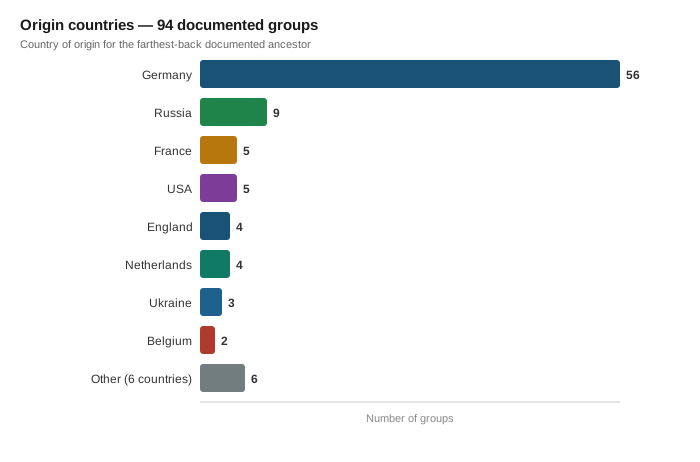
The overwhelming majority of documented Dillman family groups trace their origins to German-speaking regions of Europe. Of the 94 groups analyzed, 56 — nearly 60 percent — originate from present-day Germany. The remaining 40 percent represent a striking diversity of origins stretching across fourteen additional countries, reflecting both the complexity of European borders over the past five centuries and the wide reach of German migration into neighboring regions.
Germany accounts for 56 groups (59.6%), followed by Russia at 9 groups (9.6%), France at 5 groups (5.3%), and the United States at 5 groups (5.3%). England and the Netherlands each contribute 4 groups (4.3%), while Ukraine accounts for 3 (3.2%). Belgium, Austria, Poland, Romania, Sweden, Israel, and Belarus each appear in one or two groups, reflecting the genuinely cosmopolitan distribution of the Dillman surname across Europe and beyond.
The French-origin groups are concentrated almost entirely in Alsace and Alsace-Lorraine — the historically German-speaking borderland that alternated between French and German sovereignty for centuries. Including these Alsatian groups, the proportion of groups with German cultural origins rises to well above 60 percent.
🗺️ The Russian German Connection
One of the most distinctive findings in the Family Group data is the significant cluster of Dillman families who trace their origins not to Germany directly but to the Russian Empire — specifically the Volga German colonies established in the 18th century at the invitation of Catherine the Great. Ten of the 94 documented groups (10.6%) originate from Russian German communities, most concentrated in the Norka and New Norka colonies on the Volga River in Saratov province, and the Black Sea German colonies near Odessa.
These families descend from German settlers who emigrated to Russia in the 1760s and 1780s, maintained their German language, culture, and surname forms for generations in Russia, and then emigrated again — primarily to the United States and Canada — in the late 19th and early 20th centuries. Their migration routes were distinctive: many entered North America through Quebec or Halifax, crossed into the American Midwest via the Canadian border, and settled in Nebraska, Kansas, North Dakota, Oregon, and Wisconsin.
Groups 53 and 54 illustrate this pattern vividly. Both originate from New Norka, Saratov; both settled initially in Saskatchewan, Canada; and both were ultimately headed to Scott’s Bluff, Nebraska. Groups 50 and 87, both from Norka, Saratov, arrived within days of each other in Philadelphia in March 1906 and both settled in Portland, Oregon — almost certainly connected by a social network that preceded their emigration.
When Did They Come?
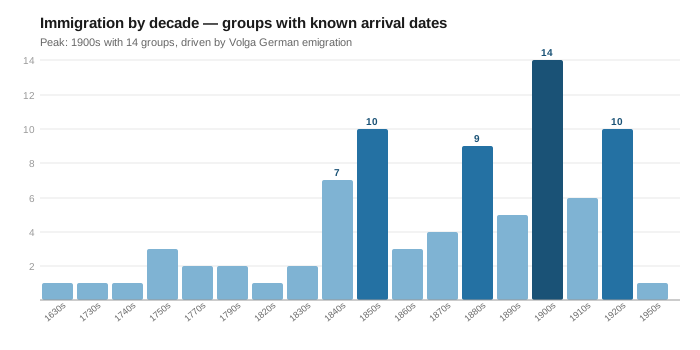
The immigration timeline spans nearly four centuries, from the Tilghman family of Kent, England, who arrived in Virginia in 1637 or 1638 (Group 17), to the most recently documented group, which emigrated to Australia in 1950. The 1900s (1900–1909) saw 14 groups immigrate — the highest of any decade — reflecting the wave of immigration preceding World War I and including the significant cluster of Russian German families leaving the Volga colonies. The 1850s and 1920s each produced 10 groups.
The earliest arrivals predate American independence. Group 29 — Hans Georg Diehlmann of Zweibrücken, Germany — arrived in Philadelphia in September 1737, making his family the first documented Dillman to reach North America, followed by Group 7 (1740), Group 1 (1740s), Group 2 (1751), and Group 3 (1755). All five of these colonial-era arrivals landed in Philadelphia — the primary port of entry for German immigrants to 18th-century America.[1]
Where Did They Settle?
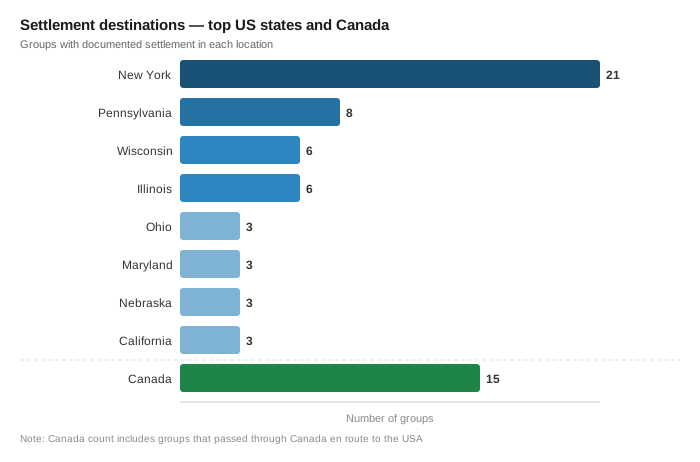
New York was the most common first point of settlement in the United States, appearing as the destination for 19 of the documented groups. Pennsylvania follows with 8 groups, Wisconsin with 6, and Illinois with 5. Beyond the United States, 15 of the 94 documented groups have a Canadian presence, making Canada the second most common country of settlement — serving both as a primary destination for Russian German groups entering through Quebec and Halifax, and as a transit point for families ultimately bound for the American Midwest.
The geographic reach extends to six continents. Brazil appears in 2 groups. Australia in 2 groups. Group 47 — Dihlmanns from Baden, Germany — settled in Valparaiso, Chile. Group 85, a Dutch-origin family, sent a branch to South Africa around 1875. Group 7 has connections to Panama. The Dillman name, in one spelling or another, has circled the globe.[2]
The Many Spellings of One Name
One of the most practical findings in the Family Group data for researchers is the extraordinary range of spelling variants associated with the Dillman surname. Across the 94 documented groups, more than 30 distinct spelling variants appear in records. The most common form in original German records is Dillmann, appearing in 48 groups — more than half the total. Dielmann is the second most common at 14 groups, reflecting a regional variant widespread in Hesse and parts of Rhineland-Palatinate. Dillman (without the final -n) appears in 7 groups, representing the standard Americanized form. Other significant variants include Tillmann (4 groups), Diehlmann (3 groups), Dilman (3 groups), Delmon (3 groups), Dihlmann (2 groups), Tilghman (2 groups), and Deelman (2 groups).[3]
Less common but documented variants include Daegen, Degen, Dallman, Dollman, Dahlmann, Dalmann, Dellmann, Delman, Dieleman, Dulman, Drillmann, Dhyllmann, Dillimann, Dylman, and Daelmans. Group 78 provides a cautionary note: one family included in the dataset carries the surname Dittmann — not Dillmann — but was repeatedly misindexed as Dillmann due to the handwriting style of 19th-century German church records. Researchers are advised to examine original documents whenever a Dillman record seems anomalous.
DNA Research and the Question of Common Ancestry
Of the 94 documented groups, 21 (22.3%) participate in the Dillman DNA Project hosted at FamilyTreeDNA (FTDNA). The project has answered a question that documentary research alone could not resolve: are all these Dillman families related?
The answer, in the majority of cases, is no. DNA (Deoxyribonucleic Acid) testing has established that there are at least 12 genetically distinct Dillman lines in North America, confirming that the Dillman surname arose independently in multiple locations across the German-speaking world rather than descending from a single common ancestor.[4] This finding is consistent with what is known about German surname adoption in the 15th and 16th centuries: surnames were adopted locally, often based on geographic features, occupations, or given names, and the same surname could emerge independently in multiple villages with no family connection.
Among the groups participating in DNA testing, haplogroups documented in the fact sheets include R1b (Group 14, Ettlingen, Baden), J2 (Group 16, Kapsweyer, Rhineland-Palatinate), and I-M170 (Group 7, the Dillman/Dagga family). These haplogroups reflect the underlying paternal-line diversity of the groups — not just different surname origins but different deep ancestral lineages extending back thousands of years before surnames existed.
Jewish and Hebrew Dillman Families
Five of the 94 documented groups carry the Dillman surname or a close variant but trace their origins to Jewish communities in Eastern Europe, Ukraine, Romania, Israel, and Belarus. These families are not of German descent; they adopted phonetically similar surnames under the surname laws imposed across the Habsburg and Russian Empires in the early 19th century, which required Jewish families to take hereditary surnames for the first time. The phonetic similarity to Dillman is coincidental rather than genealogical.
Groups 20 and 52 both originate from Litin in what is now Ukraine and are likely related. Group 42 is from Romania. Group 82 traces to Palestine/Israel. Group 86 originates from Gomel, Belarus — one family member notably arriving in New York aboard the RMS Lusitania in 1908, six years before that ship’s famous sinking. The DFA includes these groups because researchers tracing Dillman lines may encounter these families in indexes and databases.
The Oldest Documented Lines
The Family Group data reaches back to the 15th century. Group 30 — the Dielemans of Zeeland and East Flanders, Belgium — traces its line to Petrus Dieleman, born approximately 1450 in Wachtebeke, East Flanders, and died in 1533.[5] This remarkable group produced 144 documented immigrants to North America, Australia, and elsewhere — by far the most prolific migration group in the entire dataset. Virtually all 144 can be traced back to this single 15th-century ancestor.
Group 3, the Erich Dihlmann Group, documents Michael Georg Dhyllmann, born approximately 1500 in the Kraichgau area of Germany and recorded in Wurmberg in 1536. Group 6, the Lembach Dillmanns of Alsace, traces to Wendell Dillmann, born around 1522 in Lembach, France. These three groups represent the longest documented Dillman lines in the association’s records.
Notable Family Members Across the Groups
The Family Group Fact Sheets document a wide range of notable individuals. Group 2 — the Conrad Dillmann line of Neureut, Baden, the largest single family line with approximately 8,000 documented descendants — includes Richard “Dick” Bruce Cheney, former Vice President of the United States, and actor Bradford Dillman (1930–2018), known for roles in Compulsion, Escape from the Planet of the Apes, and Piranha.
Group 3 includes August Dillmann (1823–1894), a renowned Ethiopic scholar and Old Testament exegete at the University of Berlin, and his brother Christian Heinrich Dillmann (1829–1899), founder of the Dillmann Gymnasium in Stuttgart, Germany. Group 21 includes Hugh Dillman (1885–1956), a Broadway and silent film actor who married Anna Harriett Thompson Dodge — the widow of Horace Dodge and one of the wealthiest women in the world at the time. Group 22 includes Frederick Dielman (1847–1935), an American artist and sculptor. Group 85 is associated with Christian Felling Deelman, a young Oxford scholar for whom the Christian Deelman Travel Fund was established at Christ Church College following his untimely death in 1964 at age 26.
A Living Dataset
The 94 groups analyzed here represent the majority but not the entirety of the DFA’s documented family groups. Groups 25 and 46 were not available at time of publication, and groups above 96 — extending through Group 163 and beyond — remain to be incorporated. As additional groups are documented, the statistical picture presented here will grow more complete and more precise.
What the current data already makes clear is that the Dillman surname is not a single story but many stories — of German farmers and craftsmen making the Atlantic crossing in the 18th and 19th centuries, of Russian German colonists making a second migration after generations on the Volga steppe, of Belgian weavers and Dutch bankers and English cobblers and French hotel keepers who all arrived in North America carrying a name that sounded, to the ears of American record-keepers, like Dillman. Each group is a distinct family with its own history. Together, they form something larger: the most comprehensive portrait of a surname that any genealogical society has ever assembled.
The Dillman Family Association’s Family Group Fact Sheets are available to members at dillmanfamilyassociation.org. Researchers interested in contributing to or joining a specific family group are encouraged to contact the DFA. The Dillman DNA Project is open to all male-line Dillman descendants and is hosted at FamilyTreeDNA; contact the project administrator at dnaprojectadmin@dillmanfamilyassociation.org to participate. Information is current as of the date of this article.
Sources
- Dillman Family Association, Family Group Fact Sheets, Groups 1–96 (various dates 2021–2024), dillmanfamilyassociation.org.
- Dillman Family Association, Family Group Fact Sheets, Groups 30, 47, 60, 80, 85 (various dates 2021–2024).
- Dillman Family Association, “The Dillman Surname,” dillmanfamilyassociation.org/the-dillman-surname/ (accessed June 2026).
- Dillman Family Association, Dillman DNA Project, dillmanfamilyassociation.org/dillman-dna-project/ (accessed June 2026).
- Dillman Family Association, Family Group Fact Sheet, Group 30 — Dielemans of Zeeland and East Flanders (2021). See also ancestors.nl.
AI Disclosure: This article was researched and written with the assistance of Claude, an AI assistant developed by Anthropic. Statistical data is drawn directly from the Dillman Family Association’s Family Group Fact Sheets. All figures reflect the groups documented to date and will be updated as additional groups are added to the study.
Discover more from Dillman Family Association
Subscribe to get the latest posts sent to your email.