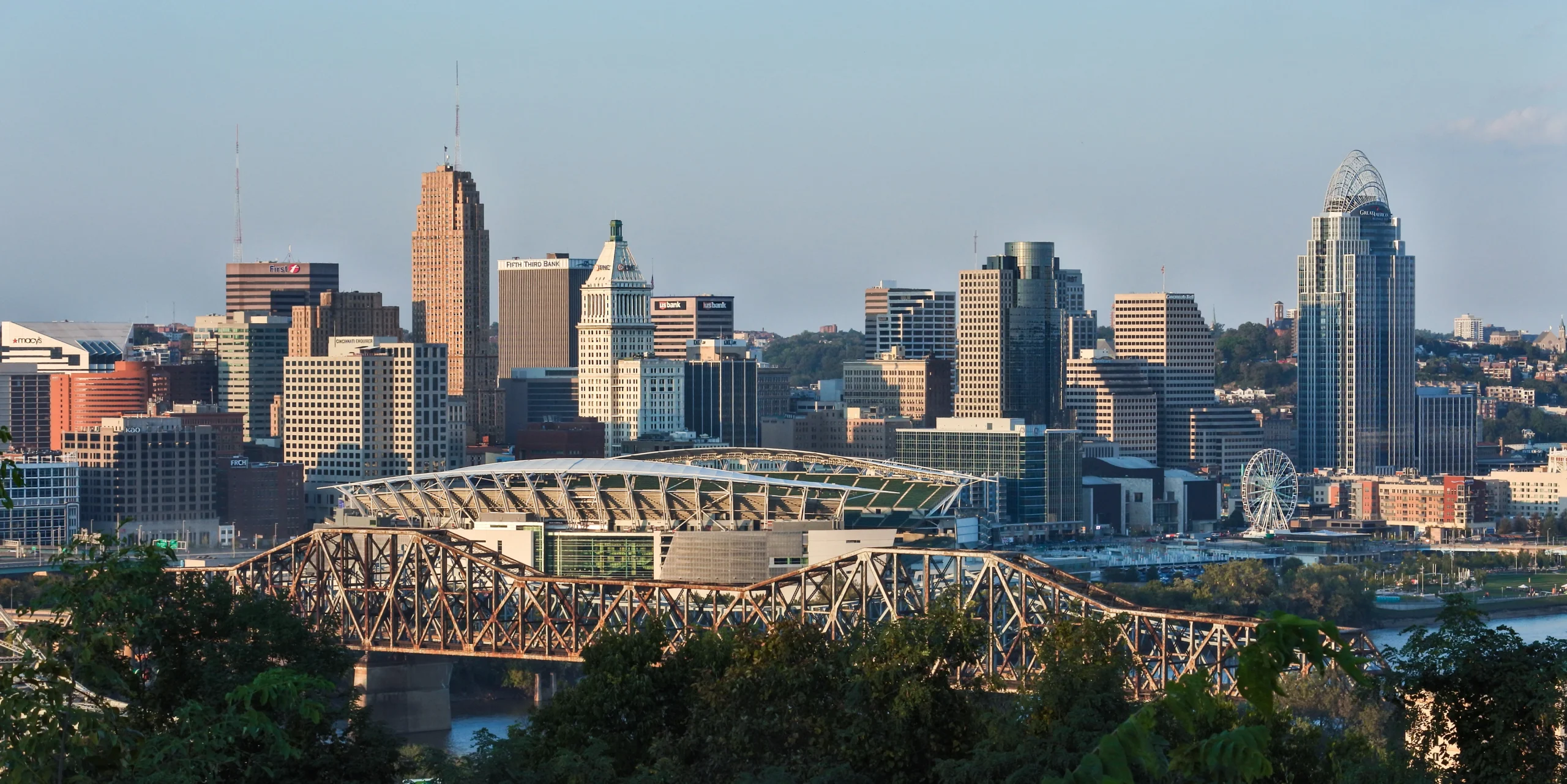
Cincinnati, Ohio, is one of the great German-American cities of the United States — and for researchers tracing Dillman lines through Ohio and the surrounding states, it is both a fascinating destination and a genuinely productive research stop. The city sits at the heart of what historians call the “German Triangle,” the three-cornered region anchored by Cincinnati, Milwaukee, and St. Louis that absorbed the largest concentrations of German immigrants in 19th-century America.[1] By the mid-1800s, Cincinnati was sometimes called the most German city in America — German was spoken in its streets, its schools, its newspapers, and its churches. Nearly half of all Cincinnati residents today claim some German ancestry.
For Dillman Family Association (DFA) members, Cincinnati is relevant on multiple levels. The city and its surrounding Hamilton County were home to documented Dillman families in the 19th century, appearing in census records, city directories, and church registers. And even for Dillman lines that passed through Ohio without settling in Cincinnati itself, the city’s extraordinary German research resources — its genealogical library, its archives, its historical society — make it a valuable stop for anyone tracing German-American ancestry in the Ohio River valley.
This guide covers the sites and experiences most relevant to DFA members: the German heritage landmarks, the genealogical research institutions, and the cultural experiences that bring Cincinnati’s German past to life.
The German Triangle and Cincinnati’s Place in It
Cincinnati’s German story began in earnest in the 1830s, when German immigrants — many of them fleeing economic hardship and political instability in the German states — began arriving in large numbers. By 1830, just 5% of Cincinnati’s growing population was German-born. Within a decade that figure had risen to 30%, and it continued to climb. By the mid-1800s Cincinnati had one of the highest concentrations of German-born residents in the country.
Germans began congregating in an area north of the Miami and Erie Canal, which separated the area from downtown Cincinnati. At the end of the nineteenth century, 75% of the residents in Over-the-Rhine were German.[2] The canal reminded them of the Rhine River at home, and the neighborhood north of it became known — at first derisively, then affectionately — as Over-the-Rhine.
The origins of Cincinnati’s German population were diverse. The 1870 census recorded the birthplaces of over 49,000 Germans in Cincinnati, showing representation from across the German states — Bavaria, Prussia, Württemberg, Baden, Hesse, and others. This diversity matters for Dillman researchers: the Dillman surname is associated with multiple geographic origins in the German-speaking world, and Cincinnati’s German community drew from many of the same regions.
Over-the-Rhine — locally known as OTR — is the crown jewel of Cincinnati’s German heritage and one of the most remarkable urban neighborhoods in America. It remains one of the most enduring symbols of Cincinnati’s German past — as well as the largest intact historic district in the United States.[3] Walking through OTR today, the 19th-century streetscape of Italianate brick buildings, corner saloons turned into craft breweries, and ornate church facades makes it genuinely possible to imagine what life looked like for the German immigrants who built it.
For Dillman researchers, OTR is more than a picturesque neighborhood — it is a landscape of social history directly relevant to the German-American experience. The churches, the architecture, the street grid, and the building types all reflect the specific cultural practices and economic circumstances of the working-class and merchant-class German immigrants who settled there. German immigrants often kept their language, using it in churches, schools, and four German-language newspapers. German churches, schools, clubs, saloons, beer gardens, restaurants, and theatres all found homes in the neighborhood.
Old St. Mary’s Church at 123 East 13th Street is the oldest standing Catholic church in Cincinnati, built in 1842 by German immigrants and still offering an occasional Mass in German. For researchers with Catholic German-American ancestry, St. Mary’s is both a historical landmark and a living connection to the religious community that shaped German immigrant life in Cincinnati. The church records at St. Mary’s and other OTR German parishes are a significant genealogical resource for Hamilton County Catholic families.
Findlay Market and the Brewing Heritage Trail
Ohio’s oldest continuously operated public market, Findlay Market, is now surrounded by a spate of new restaurants, shops, and bars — but it has been a working market since 1855, and it served as the commercial heart of the German immigrant community for generations. A visit to Findlay Market on a Saturday morning is still one of the most authentic Cincinnati experiences available, and it serves as the starting point for one of the city’s best historical tours.
The Brewing Heritage Trail begins at a dedicated sign just outside Findlay Market on the east side. Starting at the Brewing Heritage Trail Sign at Findlay Market, this brewing history and architecture tour walks the western portion of the Brewery District, marveling at the many remaining 19th and early 20th century structures and sharing stories of those who built or doomed these brewing empires during beer’s industrial revolution. Tours include a descent into the subterranean lager cellars of the historic Jackson Brewery — vaulted brick tunnels carved from the hillside where German brewmasters kept their lager cold year-round before mechanical refrigeration existed.
The German brewing tradition in Cincinnati was not incidental — it was foundational. Founded by a German immigrant to Cincinnati in 1853, the Christian Moerlein Brewing Company became one of the city’s great institutions[4], and its legacy is visible throughout OTR. The Brewing Heritage Trail is one of the most engaging ways to experience Cincinnati’s German past, and it operates multiple tour formats ranging from architecture-focused walks to underground tunnel explorations. Advance booking is recommended at brewingheritagetrail.org.
The German Heritage Museum
The German Heritage Museum is located in Cincinnati, Ohio, and serves as the focal point in presenting the contributions of the many German immigrants and their descendants in the Ohio River Valley and America. Located at 4764 West Fork Road in Green Township, the museum occupies a reconstructed log house originally built around 1840 by a German immigrant family — the entire structure was relocated from nearby Delhi Township and rebuilt as a museum and community gathering space.
The museum maintains a library consisting of German encyclopedias, and works on German and German-American history and genealogy. Lecture programs are held at the museum in October for German-American Heritage Month. For researchers, the library’s genealogy holdings are a practical resource. The museum is open Sundays from 1 to 4 PM and by appointment — contact the German-American Citizens League of Greater Cincinnati in advance if you plan a research-oriented visit.
The museum represents more than thirty organizations affiliated with the German-American Citizens League, which has been active in Cincinnati since 1895. These organizations — ranging from regional homeland societies (Baden, Bavaria, Württemberg, and others) to cultural and fraternal groups — maintained records of their membership over the decades that can be genealogically useful for tracing German-American families in the region.
The German-Americana Collection at the University of Cincinnati
For serious researchers, the University of Cincinnati’s German-Americana Collection is one of the most significant resources of its kind in the United States. Housed at the University of Cincinnati library, this is one of the nation’s largest collections of German history in the U.S. It features books, documents, journals, manuscripts, newspapers and pamphlets covering the culture, history and literature of German-Americans.
The collection is particularly strong in materials documenting German-American community life in the Ohio River valley — exactly the region where many Dillman lines settled in the 19th century. German-language newspapers, church records, and community organization documents are among the holdings that can yield genealogically relevant information not available through standard online databases. Contact the Blegen Library Archives at the University of Cincinnati (2602 University Circle, Cincinnati, OH 45221) to arrange a research visit.
The Hamilton County Genealogical Society and the Public Library
For hands-on genealogical research, two institutions in Cincinnati are essential stops. The Hamilton County Genealogical Society (HCGS) maintains resources specifically focused on German research in the county, including a dedicated section on records and resources for Germans in Hamilton County. The society’s publication, The Tracer, has featured articles on specific German regional connections to Hamilton County — including the Osnabrück region, which sent many emigrants to Cincinnati in the 19th century. The HCGS website at hcgsohio.org is a useful starting point for planning a research visit.
The Public Library of Cincinnati and Hamilton County (PLCH) maintains one of the most comprehensive local genealogy collections in Ohio. The library has digitized city directories in downloadable PDF format from 1819 to 1941.[5] The 1825 directory includes occupations and places of birth of each inhabitant. These directories are invaluable for tracing the movements of German-American families through Cincinnati across the 19th century — a Dillman listed in the 1860 city directory can be located in the same household in the 1860 federal census, and the combination provides a richer picture than either source alone. The library’s collection also includes Cincinnati birth and death records from 1865 to 1912 and Hamilton County probate records.
Spring Grove Cemetery and Arboretum
Spring Grove Cemetery and Arboretum is a nonprofit rural cemetery and arboretum located at 4521 Spring Grove Avenue, Cincinnati, Ohio. At a size of 733 acres, it is the third largest cemetery in the United States.[6] It is also a National Historic Landmark and one of the finest examples of 19th-century rural cemetery design in America — its landscaping was the work of Adolph Strauch, a German-born landscape architect who reshaped American cemetery design.
Spring Grove is more than a beautiful park. It is the final resting place of thousands of Cincinnati’s German immigrant families, and its records are available online through the Spring Grove website. For Dillman researchers with Hamilton County connections, a search of Spring Grove’s burial records is a logical step — and a walk through its grounds, past the elaborate Victorian monuments erected by German-American merchants and community leaders, is a moving encounter with the ambition and achievement of Cincinnati’s immigrant generations. The cemetery office can assist with locating specific burials.
Oktoberfest Zinzinnati
If your research visit coincides with September, Oktoberfest Zinzinnati is an experience worth building your itinerary around. Since its debut in 1976, it has grown into America’s largest Oktoberfest, attracting over 575,000 attendees annually.[7] Held each September on the streets of downtown Cincinnati near the riverfront, the festival features traditional German music, dancing, food, and beer — and it reflects the genuine depth of German cultural identity that has persisted in Cincinnati across generations. For DFA members who want to experience something of the cultural world their Dillman ancestors inhabited, Oktoberfest Zinzinnati offers a vivid if exuberant approximation.
Dillman Connections to Cincinnati and Hamilton County
Documentary evidence places Dillman families in Hamilton County and the broader southwestern Ohio region throughout the 19th century. Census records, city directories, and church registers document Dillman households in the area across multiple decades. As with most German immigrant surnames, the Dillman name appears in various spellings in Hamilton County records — Dillmann, Dilman, and phonetic variants are all worth searching when working through local sources.
The connection between Cincinnati’s German community and the broader Dillman migration pattern in Ohio is more than coincidence. Many Dillman families who settled in southwestern Ohio passed through or near Cincinnati on routes of westward migration, and some remained. The city’s German churches — Lutheran, Reformed, and Catholic — kept baptismal, marriage, and burial records that predate Ohio civil registration, making them essential sources for tracing 19th-century German-American families. The Archdiocese of Cincinnati Genealogy Archives (212 East Eighth Street, Cincinnati, OH 45202) holds Catholic records for the region.
For DFA members who have traced Dillman lines to Hamilton County specifically, a coordinated research visit combining the PLCH genealogy collection, the HCGS resources, and the Archdiocese archives — depending on the religious affiliation of the family — can yield significant documentary findings. Connecting those documentary findings with results from the Dillman DNA Project creates the strongest possible evidentiary foundation for Dillman family history in the Ohio River valley region.
Over-the-Rhine is located just north of Cincinnati’s Central Business District and is walkable from downtown hotels. The German Heritage Museum (4764 West Fork Rd., Cincinnati, OH 45247) is open Sundays 1–4 PM and by appointment. The Public Library of Cincinnati and Hamilton County main branch is at 800 Vine Street. The Hamilton County Genealogical Society can be reached at hcgsohio.org. Spring Grove Cemetery is at 4521 Spring Grove Avenue. Oktoberfest Zinzinnati is held annually in September; dates and details at oktoberfestzinzinnati.com. Prices, hours, and event details are current as of the date of this article and are subject to change.
Sources
Historical marker, “Cincinnati’s German Heritage,” erected 2001 by Ohio Bicentennial Commission and German-American Citizens League of Greater Cincinnati, hmdb.org (accessed May 2026).
Visit Cincy, “Oktoberfest Zinzinnati,” visitcincy.com (accessed May 2026).
AI Disclosure: This article was researched and written with the assistance of Claude, an AI assistant developed by Anthropic. All facts have been reviewed for accuracy, but readers are encouraged to verify hours, admission prices, and event dates independently before visiting, as these are subject to change.
Websites store cookies to enhance functionality and personalise your experience. You can manage your preferences, but blocking some cookies may impact site performance and services.
Essential cookies enable basic functions and are necessary for the proper function of the website.
Name
Description
Duration
Cookie Preferences
This cookie is used to store the user's cookie consent preferences.
30 days
These cookies are needed for adding comments on this website.
Name
Description
Duration
comment_author
Used to track the user across multiple sessions.
Session
comment_author_email
Used to track the user across multiple sessions.
Session
comment_author_url
Used to track the user across multiple sessions.
Session
Google reCAPTCHA helps protect websites from spam and abuse by verifying user interactions through challenges.
Name
Description
Duration
_GRECAPTCHA
Google reCAPTCHA sets a necessary cookie (_GRECAPTCHA) when executed for the purpose of providing its risk analysis.
179 days
These cookies are used for managing login functionality on this website.
Name
Description
Duration
wordpress_logged_in
Used to store logged-in users.
Persistent
wordpress_sec
Used to track the user across multiple sessions.
15 days
wordpress_test_cookie
Used to determine if cookies are enabled.
Session
Consent compliance tool
Name
Description
Duration
wp_consent_statistics-anonymous
4 weeks
wp_consent_statistics
4 weeks
wp_consent_preferences
4 weeks
wp_consent_marketing
WPConsent Consent compliance tool
4 weeks
wp_consent_functional
4 weeks
Statistics cookies collect information anonymously. This information helps us understand how visitors use our website.
Google Analytics is a powerful tool that tracks and analyzes website traffic for informed marketing decisions.
Contains information related to marketing campaigns of the user. These are shared with Google AdWords / Google Ads when the Google Ads and Google Analytics accounts are linked together.
90 days
__utma
ID used to identify users and sessions
2 years after last activity
__utmt
Used to monitor number of Google Analytics server requests
10 minutes
__utmb
Used to distinguish new sessions and visits. This cookie is set when the GA.js javascript library is loaded and there is no existing __utmb cookie. The cookie is updated every time data is sent to the Google Analytics server.
30 minutes after last activity
__utmc
Used only with old Urchin versions of Google Analytics and not with GA.js. Was used to distinguish between new sessions and visits at the end of a session.
End of session (browser)
__utmz
Contains information about the traffic source or campaign that directed user to the website. The cookie is set when the GA.js javascript is loaded and updated when data is sent to the Google Anaytics server
6 months after last activity
__utmv
Contains custom information set by the web developer via the _setCustomVar method in Google Analytics. This cookie is updated every time new data is sent to the Google Analytics server.
2 years after last activity
__utmx
Used to determine whether a user is included in an A / B or Multivariate test.
18 months
_ga
ID used to identify users
2 years
_gali
Used by Google Analytics to determine which links on a page are being clicked
30 seconds
_ga_
ID used to identify users
2 years
_gid
ID used to identify users for 24 hours after last activity
24 hours
_gat
Used to monitor number of Google Analytics server requests when using Google Tag Manager
1 minute
Name
Description
Duration
_clck
Stores a unique user ID to recognize returning visits and keep session settings consistent.
1 year
_clsk
Connects multiple page views within a single browsing session to provide accurate session data.
1 day
MUID
Microsoft user identifier used to identify unique browsers. Used for analytics and operational purposes.
1 year
ANONCHK
Indicates whether a browser ID is transferred to the MUID cookie. For Clarity this is always set to 0, indicating no ad tracking.
10 minutes
MR
Indicates whether to refresh the MUID cookie. Used by Microsoft for analytics purposes.
7 days
SM
Used to synchronize the MUID cookie across Microsoft domains.
Session
Marketing cookies are used to follow visitors to websites. The intention is to show ads that are relevant and engaging to the individual user.
A video-sharing platform for users to upload, view, and share videos across various genres and topics.
Registers a unique ID on mobile devices to enable tracking based on geographical GPS location.
1 day
VISITOR_INFO1_LIVE
Tries to estimate the users' bandwidth on pages with integrated YouTube videos. Also used for marketing
179 days
PREF
This cookie stores your preferences and other information, in particular preferred language, how many search results you wish to be shown on your page, and whether or not you wish to have Google’s SafeSearch filter turned on.
10 years from set/ update
YSC
Registers a unique ID to keep statistics of what videos from YouTube the user has seen.
Session
DEVICE_INFO
Used to detect if the visitor has accepted the marketing category in the cookie banner. This cookie is necessary for GDPR-compliance of the website.
179 days
LOGIN_INFO
This cookie is used to play YouTube videos embedded on the website.