
Genealogy has always been about going back as far as the documents allow. Church registers, census records, probate files, ship manifests — each source type has its horizon, and the researcher’s goal is to push beyond each one to the next. For most American family lines, the documentary horizon sits somewhere between the seventeenth and nineteenth centuries, depending on the country of origin and the survival of records. Ancient DNA research is revealing what lies beyond that horizon, and what it is showing is both more remarkable and more unsettling than most genealogists expect.
Over the past decade, the sequencing of DNA from ancient human remains has fundamentally rewritten our understanding of European population history. The findings are directly relevant to anyone researching central European ancestry — which means they are directly relevant to Dillman researchers. Your documented ancestors were themselves descended from populations that arrived in central Europe in waves of migration stretching back thousands of years before the earliest documents exist, and the genetic traces of those migrations are carried in your DNA today.
The Three Waves That Made Modern Europeans
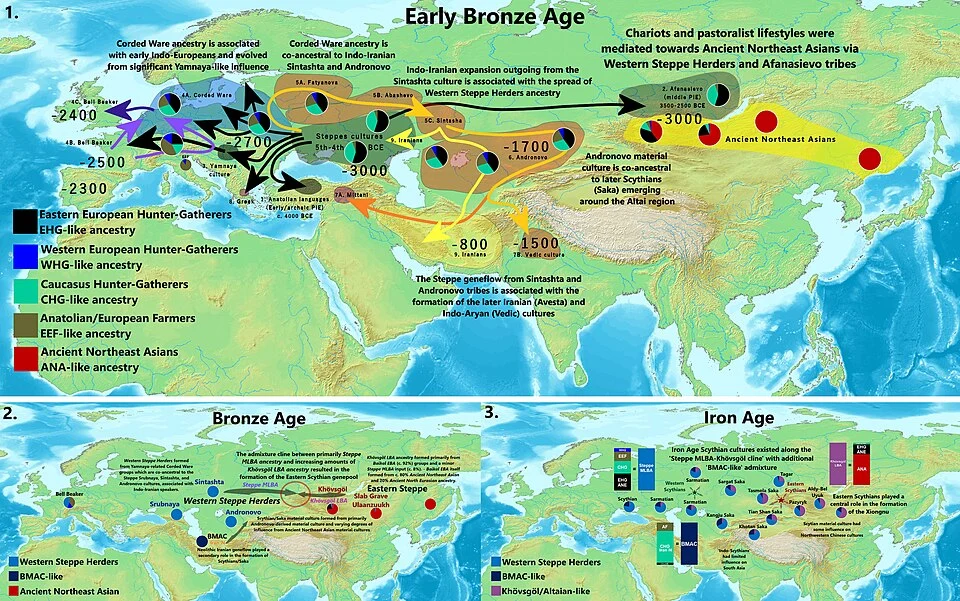
When ancient DNA studies began to gain attention, little more than a decade ago, the view took hold among geneticists that everything we thought we knew about the peopling of Europe by modern humans was wrong. The story was simpler than anyone was expecting: Europe was settled in just three massive migrations from the east. First came the hunter-gatherers, more than 40,000 years ago. Then, after 9,000 years ago, there was an expansion of farming people from Anatolia during the Neolithic age. Finally, from 5,000 years ago, the Corded Ware people expanded out of the Russian steppe to inaugurate the European Bronze Age. The Corded Ware people, who carried a distinctive genetic signature previously absent from most of Europe, were named after the cord-like impressions in their pottery. Their descendants are, in all likelihood, among your ancestors.
What this means in practical terms: when an ethnicity estimate says your DNA is “Germanic,” it is detecting a combination of these three ancestry components in proportions typical of modern central Europeans — not tracing your ancestors to a medieval German village. The “German” in your DNA arrived from Anatolia as a farmer 7,000 years ago, from the Pontic steppe as a herder 5,000 years ago, and from Paleolithic western Europe as a hunter-gatherer even before that.
The Revolution Is Still Happening
Ancient DNA research is not a settled field. One of the most valuable uses of ancient DNA is to help understand how culture and genealogy are related. When people move en masse from one place to another, carrying their culture with them, the appearance of new culture and new genealogical lineages may be easily apparent. But it has been more challenging to see the genealogical effects of trade and interchange between established population centers. That challenge is now being met, study by study, with findings that continue to surprise researchers.
A 2026 study published in Nature analyzed nearly 650 skeletons from late Avar-period cemeteries near Vienna, mapping genetic relationships within and between communities in unprecedented detail. The Avars originated as steppe peoples before settling in central Europe north of East Roman provinces in the Balkans, and the study revealed that genetic relatives across distant sites could be identified — demonstrating that the population movements of the first millennium CE were more complex and more genetically consequential than documentary history alone suggests.
A separate 2026 study in Nature Ecology documented something even more striking for anyone with French ancestry: ancient DNA from a tomb near Paris reveals a shocking prehistoric reset — one population vanished and was replaced by newcomers from the south. The two groups show no genetic connection, signaling a major upheaval around 3000 BC. The people who lived in the Paris Basin in 3000 BC had no detectable genetic connection to the people who lived there in 2500 BC. Entire populations were replaced, leaving no traceable descendants.
Meanwhile, research on the Bronze Age expansion revealed a story about gender and mobility: ancient DNA shows that Neolithic populations in Belgium and the Netherlands had farming knowledge likely introduced by women from southern farming communities, while local men maintained hunter-gatherer ancestry. The genetic history of Europe is not a story of uniform population replacement but of complex, asymmetric mixing in which men and women often moved in different patterns and at different rates.
What This Means for Your Ethnicity Results
The ancient DNA revolution has a specific, direct implication for the ethnicity estimates discussed in our previous article: the genetic patterns that algorithms detect as “German” or “Scandinavian” or “French” were established not by medieval populations but by Bronze Age and Neolithic ones, thousands of years before those national identities existed.
Ancient DNA research has revealed that European population structure changed dramatically in the prehistoric period — 14,000 to 3,000 years before present — reflecting the widespread introduction of Neolithic farmer and Bronze Age Steppe ancestries. However, population structure has been relatively stable since the Iron Age, despite high mobility. This is a remarkable finding for genealogists: the genetic landscape of Europe was essentially established before 1000 BC and has remained broadly stable since, despite the Roman Empire, the Viking expansion, the medieval migrations, and all the other historical movements that are well-documented in the written record.
What this means is that your “Germanic Europe” percentage on AncestryDNA is not primarily detecting ancestry from people who identified as Germans or Franks or Saxons in any historical sense. It is detecting a combination of Steppe, Anatolian farmer, and Western Hunter-Gatherer ancestry in proportions typical of what the Bronze Age Corded Ware culture left behind in central Europe. Your Dillman ancestors from 18th-century Hesse were themselves carrying this deep inheritance, and it was already thousands of years old when they boarded their ships for America.
Ancient DNA Tools for Genealogists
The research findings described above are published in academic journals and are not directly usable for personal genealogical research. But several tools have emerged that allow genealogists to engage with ancient population data in a practical way.
GEDmatch provides access to several ancient population reference sets that allow users to model their own DNA as a mixture of ancient European ancestry components. These tools — variously labeled as “Admixture” or “Oracle” analyses — can estimate the proportions of WHG, EEF, and Steppe ancestry in a tester’s genome. These results are not genealogically interpretable at the level of specific ancestors, but they do provide a fascinating deep-time perspective on personal ancestry.
AncestryDNA’s historical migration groups attempt to connect modern users to documented historical population movements — the Germanic Iron Age, the Norse migrations, the Roman-era Mediterranean diaspora. These are hypotheses about which historical migrations most plausibly explain a user’s DNA pattern, not documentary genealogical conclusions.
Population genetics tools like the publicly available G25 calculator and GLOBE13 allow more technically inclined users to model their ancient ancestry components against a wide range of ancient reference populations. These tools require some technical comfort but produce the most detailed ancient ancestry analysis available to non-specialists.
For Dillman Researchers
The ancient DNA research on central Europe is specifically informative for Dillman family history. The DFA’s Family Group Sheet database places the majority of Dillman origins in Hesse, Baden, and the Rhineland — the heartland of the Bell Beaker and Corded Ware cultures that ancient DNA research has identified as the primary vectors through which Steppe ancestry entered western and central Europe. Dillman males who test their Y-DNA through the Dillman DNA Project on FamilyTreeDNA will likely find themselves in haplogroups — particularly R1b and R1a — that are themselves the genetic signature of the Bronze Age Steppe expansion. The Y chromosome a Dillman carries today may have entered central Europe not with a medieval Dillmann ancestor but with a Corded Ware herder 4,500 years ago.
This does not make documentary genealogy less important — it makes it more legible. Understanding that the genetic patterns ancient DNA research detects in your results are prehistoric in origin helps explain why ethnicity estimates look the way they do, why closely related European populations are genetically nearly indistinguishable, and why your “German” DNA and your cousin’s “Scandinavian” DNA look so similar at the deep level. You are both carrying the same Bronze Age inheritance, sorted by geography over a few thousand years of drift.
Sources
Phys.org. “DNA study uncovers continental origins of Britain’s Bronze Age population.” March 2, 2026. phys.org. Citing Workman et al., Nature 652 (2026), DOI: 10.1038/s41586-026-10111-8.
ScienceDaily. “Ancient DNA reveals a lost population near Paris replaced by strangers.” April 22, 2026. sciencedaily.com. Citing Seersholm et al., Nature Ecology 10 (2026), DOI: 10.1038/s41559-026-03027-z.
ScienceDaily. “Ancient DNA reveals how women helped transform prehistoric Europe.” May 30, 2026. sciencedaily.com.
Hawks, John. “Top 10 discoveries about ancient people from DNA in 2025.” December 19, 2025. johnhawks.net.
Featured image: “Overview of the Genetic History of the Bronze to Iron Age Eurasian Steppe.” Wikimedia Commons. CC BY-SA 4.0. commons.wikimedia.org.
Margaryan, Ashot, et al. “Stable population structure in Europe since the Iron Age, despite high mobility.” eLife 12 (2023). ncbi.nlm.nih.gov.
Note: This post was researched and written with the assistance of artificial intelligence (AI). All content has been reviewed for accuracy as of August 2026. All errors are the responsibility of the author.
Discover more from Dillman Family Association
Subscribe to get the latest posts sent to your email.